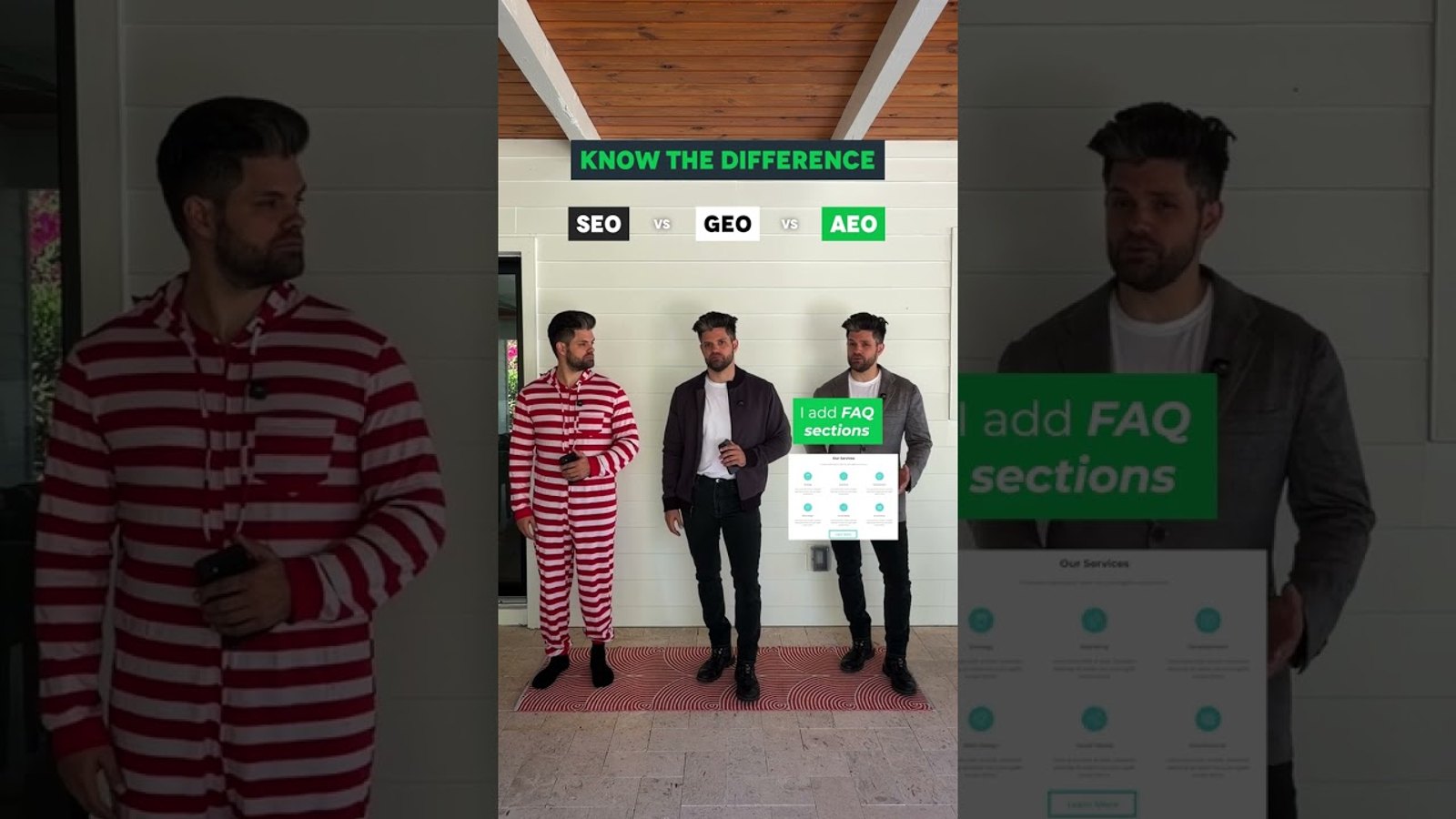
SEO vs GEO vs AEO names three places a business shows up: Google rankings, AI recommendations, and quoted answers. The work overlaps, and in my 216-market study, 87.6% of businesses Google's AI Overview named were already in its local pack. In a short video comparing SEO vs GEO vs AEO, I walk through how I use and measure each one.
What is the difference between SEO vs GEO vs AEO?
SEO gets you ranked on Google, GEO gets you recommended by AI tools like ChatGPT, and AEO gets your answer quoted. Google's own guidance on AI features says the same SEO basics apply to AI Overviews. Treat them as three places to check your business.
SEO is search engine optimization, GEO is generative engine optimization, and AEO is answer engine optimization. Plenty of good operators start where one agency reviewer did: "I know nothing about SEO or websites."
If the acronyms feel like noise, you are in good company. One owner on r/smallbusiness admitted to "feeling quite overwhelmed by all this info". Another agency reviewer only wanted "basic SEO help to make a new website show up in Google searches".
SEO vs GEO vs AEO side by side for a local business
SEO
Gets your website and Business Profile ranked in Google's results and the Map Pack. You measure it by rankings, organic traffic, and calls. In my study, Google's local pack held at 0.82 overlap week to week.
GEO
Gets your business recommended inside AI answers from ChatGPT, Gemini, Perplexity, and Claude. You measure it by how often AI names you. In my study, ChatGPT's panel held at only 0.36 overlap.
AEO
Gets your content pulled in as the direct answer in AI Overviews, featured snippets, and voice assistants. You measure it by how often you are quoted. In my study, AI Overviews fired on 25.9% of local buying queries.
GEO and AEO grow out of the same SEO foundations
For a local business, one set of foundations feeds all three: your profile, your reviews, your pages, and your listings. Google ranks that groundwork, and AI search reads it too. You do not need three vendors for three acronyms.
The overlap is measurable. In my August 2026 study, businesses that stayed in ChatGPT's answers had a median of 226 reviews. Those that dropped had 164. Both groups had the same 4.9 median rating.
The results still differ by place. ChatGPT's picks overlapped Google's local pack on 33.1% of displayed cards (323/975). Build the foundations once, then check Google and each AI tool on its own terms.
The three levels of SEO for a local business
I teach local SEO as three levels, each built on the one below. One owner noticed that "what used to move the needle quickly doesn't do as much now". In a short video on the three levels of SEO, I explain what moves a business up each level.
- Level one, you rank on Google. Build one page per service with the city in the heading, plus one location page per city you serve.
- Level two, you rank in the Map Pack. Fully optimize your Google Business Profile, build a steady review habit, and answer every review.
- Level three, AI recommends your business. Show photos, job case studies, and customer stories, then get mentioned on local blogs, directories, and partner sites.
How SEO gets a local business ranked on Google
SEO earns your place in Google's organic results and the Map Pack. Google's Business Profile help page says local results rank on relevance, distance, and prominence. Start with local SEO basics before any AI work.
Relevance is how well your profile and pages match the search. Distance is how far you are from the searcher. Prominence is how well known you are, including reviews and links from other sites. Your Business Profile is where Google reads the basics: categories, hours, services, and photos.
This layer is the steadiest one you can build. In my study, Google's local pack held at 0.82 overlap between asks (n=198 markets). If you are missing from it, read why you are not in the Map Pack.
How GEO gets your business recommended by ChatGPT
GEO is the work of getting an AI tool to name your business when a customer asks who to hire. The term was introduced in a research paper on generative engine optimization first posted in November 2023. Make your business easy for these tools to read and trust.
ChatGPT reads the web fresh for each local answer, so its picks move. In my study, 48.2% of the businesses it showed were shown again days later (469/974). The same number one held in 34.1% of markets.
Consistent details, detailed reviews, and mentions on other sites give it more to find. In a short video on getting clients from Google vs ChatGPT, I pair each Google habit with its ChatGPT version.
Why GEO answers change more than SEO rankings
GEO answers change more because ChatGPT reads a different set of websites each time it answers. In my study, the websites it retrieved overlapped at just 0.20 between asks (n=197 markets). Build a presence on many trusted sites, so your business turns up whichever ones get read.
The model itself was fairly consistent. When ChatGPT came across a business it had shown before, it showed it again 72.5% of the time (469/647). The churn comes from which pages get read.
That is why I check GEO results often and Google rankings less often. Even the same question, asked the same day on a second account, agreed at only 0.43.
How AEO gets your answers quoted in AI Overviews
AEO shapes your content so an answer engine can lift it word for word, in AI Overviews, featured snippets, and voice assistants. Google says AI Overviews and AI Mode have no extra technical requirements beyond normal search. Add a short FAQ section under every service page.
For local buying questions, the AI Overview is less common than people think. In my study, it fired on 25.9% of local buying queries. Phrasing mattered: 39.1% for "who is the best" questions against 12.7% for keyword searches.
When it fired, it named about 1.8 businesses, and 1,182 of 1,683 citations went to google.com itself. Most of those citations point back to Google's own pages, which is one more reason to keep your Business Profile complete. Answer the same questions on your own site, so there is a clear page to quote.
Shaping a service page for AEO and AI Overviews
AEO on a service page comes down to short, plain answers placed where a machine can lift them.
-
A heading phrased the way customers ask the question.
-
The answer in the first sentence under it, in plain words.
-
One idea per paragraph, so each block stands on its own.
-
A real number with its source wherever you have one.
-
An FAQ block under the service details, built from questions customers actually ask.
-
FAQ structured data that matches the visible text on the page.
-
Your city and service area named in plain words.
A shared checklist for Google and AI search
These items feed SEO, GEO, and AEO at the same time.
-
A complete, accurate Google Business Profile, updated weekly.
-
Steady, detailed reviews on Google and Yelp, each one answered.
-
The same name, address, and phone number on every listing and directory.
-
One clear service page for each service, with the city named.
-
A location page for each city in your service area.
-
A short FAQ under each service page, in plain words.
-
Structured data that matches what the page says.
-
A website that Google and AI crawlers can both reach.
The order of work for SEO and AI search
- Fix the facts first: your Business Profile, your name, address, and phone, and your top listings.
- Build the pages: one per service, one per city, each answering the questions customers ask.
- Grow reviews through reputation work that runs every week, so your review count keeps climbing.
- Earn mentions from local blogs, partners, and directories that talk about your business.
- Answer common questions on your own site in short, plain blocks that AI can quote.
- Run the monthly check in the next section and fix what it shows.
How to check your business on Google and in AI search
- Search "best [service] in [city]" on Google and note your Map Pack position and organic rank.
- Search "who is the best [service] in [city]" on Google and note whether an AI Overview appears and who it names.
- Ask ChatGPT the same question, then ask "Who would you recommend and why?" and note the name it picks.
- Ask Gemini and Perplexity the same question and note where their answers differ.
- Write down the date, the question, and every business named, so you can compare month to month.
- Repeat the check monthly, because AI answers can change within days.
How to measure SEO and AI search by calls
Measure all three by the calls and booked jobs they bring, with each term's own score as a supporting signal. In my study, when ChatGPT showed a business, Google's AI Overview named it too only 14.2% of the time. Track each surface separately, then add up the calls.
For SEO, watch rankings, Map Pack position, organic traffic, and calls. For GEO and AEO, ask the same buying question every month and log who gets named. One screenshot shows one day.
One owner on r/smallbusiness put it simply: "We don't use profit as a measure of success of marketing, we use sales". Ask every new customer how they found you. My list of local SEO metrics that matter shows what to track.
Get found on Google and recommended by AI
I run AI search optimization across ChatGPT, Gemini, Google's AI, Perplexity, Claude, and Grok, alongside SEO. The work covers all three of SEO, GEO, and AEO, built on one set of foundations and measured by calls.
Talk to Spearleaf about AI search optimization
Joshua Albanese is the founder of Spearleaf. He ran the August 2026 study of 216 US markets behind the numbers in this article.
- See how each one picks: ChatGPT vs Google for a local business.
- How I read the study: what AI answers reward in local businesses.
- Start here: why your competitors outrank you.