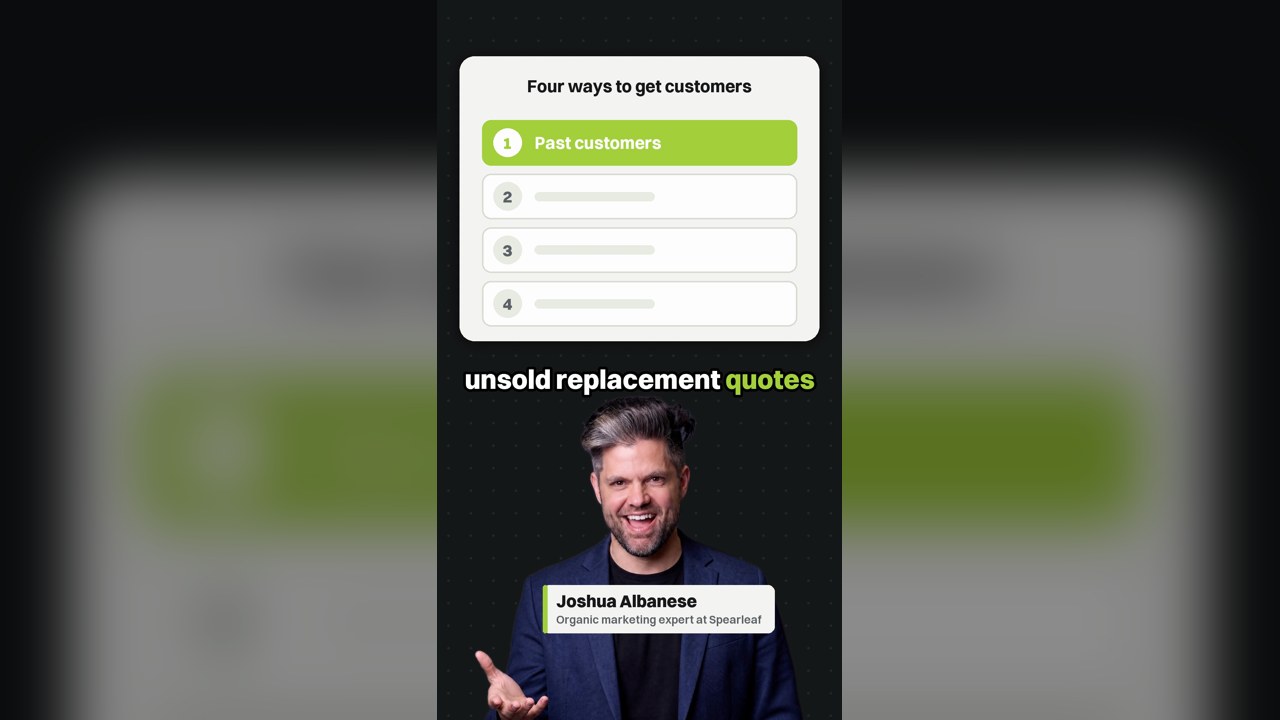
The best home service marketing strategies start with past customers, then partners, your Google listing and reviews, and paid ads last. In Joshua Albanese's short video on home service marketing, I answer a plumber whose wife says marketing means Facebook posts. Word of mouth works, but you want more consistent lead flow, so sort each channel by when it pays off.
What are the best home service marketing strategies?
The best home service marketing strategies use four ways to get customers: past customers, partners who send work, your Google listing, and paid ads. Google's help page on local ranking says there's no way to pay for a better local ranking. Use paid ads for this month, and build the other three for slow weeks and next year.
Home service businesses here means the trades that work at a customer's home: HVAC, plumbing, electrical, roofing, pest control, landscaping and lawn care, and cleaning.
Spending more is rarely the first fix. A reviewer of a marketing agency on Trustpilot wrote, "Nearly 5 months and I get only 1 lead!! The only 'input' I got from my sales rep was 'spend more money'."
Four ways home service businesses get customers, sorted by when they pay off
Past customers
People who already paid you. Calling them costs time, not ad money, and it can fill a slow week. Many trades keep this list in their invoicing software and rarely call it.
Partners who send work
Property managers for plumbers, builders for electricians, realtors and home inspectors for most trades. They take months to build, then send work in quiet stretches.
Your Google listing, reviews and website
Months of work up front. The calls that come from them carry no cost per click, and AI answers read the same reviews and pages.
Paid ads
Local Services Ads charge per lead, and search ads charge per click. They cover this month, and the calls stop when the budget does.
Start with past customers, the list many trades never call
Past customers already trust you, so a call costs time, not ad money. The plumber in my video has hundreds of past customers and has never called one. Give every call a real reason tied to their home. When the list runs long, Spearleaf also runs customer reactivation.
-
Plumbing: water heater installs from years back, since the heater's age is a real reason to check in.
-
HVAC: replacement quotes you gave and never sold, and maintenance customers who skipped a season.
-
Pest control: quarterly plans that lapsed.
-
Lawn care and landscaping: last year's seasonal customers, before spring cleanup.
-
Electrical: panel, generator or EV charger quotes that stalled.
-
Roofing: past roof customers before storm season, with an inspection offer.
-
Cleaning: one-time cleans who never booked a second visit.
Calling and texting past customers under the Do Not Call and FCC rules
Calling your own customers still has rules. The FTC's Do Not Call guidance and the FCC's rule at 47 CFR 64.1200 cover sales calls and texts:
-
Past customers on the National Do Not Call Registry can still get sales calls. The window is 18 months after their last purchase, delivery or payment.
-
After an inquiry, such as a quote request with no job, the window is three months.
-
If a customer asks you not to call, honor it, even inside that window.
-
Sales calls to homes are allowed only from 8 a.m. to 9 p.m., the customer's local time.
-
Autodialed or prerecorded sales calls to a cell phone need prior express written consent, and the rule counts a text as a call.
-
A customer can revoke consent any reasonable way, and you must honor it within 10 business days.
-
If you call numbers outside those windows, check the registry at least every 31 days. State laws can be stricter, so check yours.
Partners who send work: property managers, builders and realtors
Partners are businesses whose customers need your trade. Property managers need plumbers, builders need electricians, and realtors and home inspectors need almost every trade. They take months to build, then they can send work when the phone is quiet.
Pick three and earn their trust on small jobs first. Answer their calls first, send photos and a clear invoice the day the job closes, and keep their tenants or buyers informed.
If you pay or offer anything for a referral, put it in writing and check your state's licensing rules first. Ask whether the partner has to disclose it to their own clients.
Your Google Business Profile and reviews, under Google's and the FTC's rules
Your Google listing takes months, but those calls carry no cost per click. Google's help page says more reviews and positive ratings can help your local ranking. Keep your Google Business Profile complete, with every service and town you cover.
Ask every customer, and offer nothing for a review. Google's content policy bans any review incentive, such as a discount, and bans asking only happy customers. The FTC's 2024 rule bans fake reviews, incentives tied to a review's sentiment, and suppressing reviews with threats.
A few marketing guides still tell owners to offer a discount for a review, which breaks Google's policy. For the link, timing and QR code, see how to find your Google review link.
A website with a page for each service your home service business sells
Your website is where homeowners, Google and AI answers check what you do and where. Give each service its own page, such as water heater repair or AC replacement, and list the towns you serve.
Put your license number on the site, the trucks and every ad. California's Contractors State License Board requires it on all commercial vehicles and advertisements, including websites. It also bars contractors from advertising that they're bonded, so check your own state's licensing board.
For the full checklist, read what makes a good contractor website. Our team at Spearleaf handles web design when you want help with it.
What ChatGPT reads before it names a plumber, HVAC company or roofer
ChatGPT reads directories and review sites before it names a home service business, and the sites differ by trade. In my August 2026 study, bestprosintown.com was its most-cited site for plumbers, in 8 of 18 markets. Check yours: ask ChatGPT for the best plumber in your town and note the sites it cites.
In 8 of 18 markets, consumeraffairs.com led for HVAC companies, and expertise.com led for roofing companies in 6 of 18. Among plumber cards that matched one platform, 36.2% showed Yelp's rating (21 of 58), so keep Yelp current too.
Location and review depth mattered: 92.0% of businesses ChatGPT showed had an address in the asked city (1,790 of 1,946). Businesses it showed again on a second ask had a median of 226 reviews, against 164 for those it dropped. That's the ground AI search optimization builds on.
Local Services Ads and Google Ads for home service businesses
Paid ads cover this month, and the calls stop when the budget stops. Google's Local Services help says you're charged per valid lead, and the ad stops showing at the monthly max.
Search ads charge per click at a price the auction sets. Google doesn't charge Local Services leads it judges invalid or low quality at first contact. It reviews charged leads for 30 days and credits poor-quality, duplicate or invalid ones automatically, outside the EEA.
Eligible Local Services categories include plumbers, electricians, HVAC, roofers, pest control, landscaping, lawn care and house cleaning. The badge is now Google Verified; read what changed with the Google Verified badge.
A lead isn't a booked job, so judge paid ads by what they book
A busy board doesn't show what each job cost. A reviewer of a marketing agency on Trustpilot wrote, "I was getting ALOT of clicks and no calls". Count booked jobs per source, not leads or clicks.
Bought leads from lead sellers work the same way: you pay for the contact, not the job. The trade guides on how to get HVAC leads and how to get roofing leads cover seller questions and calling rules.
Keep the ad accounts in your company's name, so the data stays when a vendor leaves. Our team at Spearleaf runs Google Ads management for owners who want help with setup.
Social media, video, mailers and community for home service businesses
Every guide lists more channels. Here's where the rest fit, sorted by what each does best:
-
Social media posts on Facebook, Instagram and Nextdoor keep past customers remembering you, which helps way one more than new leads.
-
Short videos of real jobs and your techs answer homeowner questions on your site, your listing and YouTube.
-
Email to past customers carries seasonal reminders and maintenance plan renewals.
-
Texts confirm booked appointments; send marketing texts only with written consent.
-
Direct mail and door hangers work around a finished job, where neighbors saw your truck.
-
Trucks, uniforms and yard signs carry your name, and in some states your license number.
-
Community sponsorships, such as a youth team, build name recognition slowly.
-
Maintenance plans and service agreements turn one HVAC, pest, lawn or pool job into repeat visits.
Email and texting rules for home service marketing
Marketing email carries federal rules. The FTC's CAN-SPAM guide says it must say it's an ad, include your physical postal address and explain how to opt out. Honor opt-outs within 10 business days.
The law makes no exception for business-to-business email, so it covers notes to property managers too. Penalties run up to $53,088 per email.
Texting campaigns sent from software follow the FCC consent rule above. Collect written consent on your booking form, and keep a record of it.
The home service marketing mix: this month, slow weeks and next year
Usually it's a mix. Paid covers this month, past customers and partners help fill slow weeks, and the listing builds for next year.
-
This month: Local Services Ads or search ads, kept only while they book jobs at a profit.
-
Every slow week: a block of calls to past customers, each with a real reason.
-
Every month: one coffee or job walk with a partner, such as a property manager.
-
After every job: a review request with nothing offered in return, plus job photos for your listing.
-
Every quarter: a new service page and a ChatGPT check for your trade and town.
-
Next year: aim for more calls from the listing, partners and past customers, and fewer from paid ads.
How much should a home service business spend on marketing?
Spend what your cost per booked job supports; I haven't found a neutral source for a set percentage of revenue. Google's Local Services help lets you set an average weekly budget with a monthly max. Set paid spend from your numbers, and give past customers and partners hours, not dollars.
Raise a paid budget only when the jobs it books still leave a profit after the ad cost. Cut it when they don't.
Count which home service marketing strategies book jobs
- Ask every caller how they heard about you. One owner on r/smallbusiness put it plainly: "You'd need to ask every customer how they found you".
- Add a lead source column to your invoicing software or a spreadsheet, and fill it in for every job.
- Check your Business Profile performance monthly for calls, website clicks and direction requests.
- Note each month's spend and leads in Google Ads and Local Services Ads, then match leads to booked jobs.
- Divide each source's monthly cost by the jobs it booked. Count your own hours on past customers and partners too.
- Keep sources that book jobs at a profit, and fix or drop the rest. See the local SEO metrics that matter.
Build home service marketing that keeps working in slow weeks
Our team at Spearleaf runs local SEO for home service businesses: the Google Business Profile, reviews, service pages and the AI answers that read them. It builds the ways on this page that keep bringing calls when the ad budget stops.
Talk to Spearleaf about local SEO
- Compare them: local SEO vs Google Ads.
- Then build reviews: how to improve your Google rating.
- Start here: why you are not in the Map Pack.