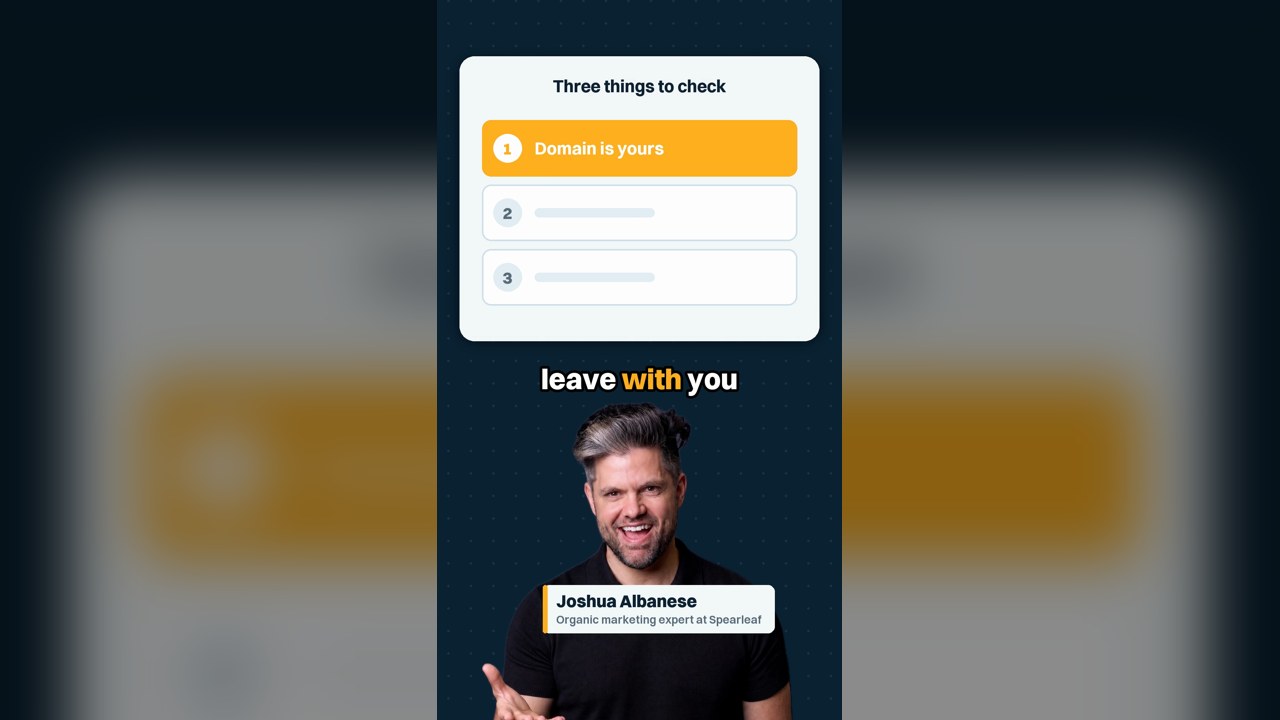
A good contractor website stays in your name, lets a homeowner call from a phone, and gives each service its own page. In my short video on contractor website design, I walk an electrician through what to ask before he hires anyone. Check those three things, plus your state's license rules, before you judge the design, so the site brings in calls.
What makes a good contractor website?
A good contractor website is yours to keep, works on a phone, explains each service, and makes calling easy. Google's SEO Starter Guide says a logically organized site can help search engines and users understand your pages. Check any web designer against those four points first.
One owner in a Trustpilot review of an agency wanted to "make a new website show up in Google searches." Showing up is half the job. The other half is a homeowner tapping call once they land on your page.
Word of mouth works for most trades. A good site adds more consistent lead flow from homeowners who have never met you.
Ownership comes first on a contractor website
Your domain should be registered in your name, on a registrar account you log into yourself. ICANN's transfer FAQ says the domain holder needs an Auth-Code to move a domain to another registrar. The registrar must provide it within five calendar days of a request.
The holder is whoever is listed as the registrant, so check that name today. The same FAQ says a domain cannot move to a new registrar within 60 days of a registrant name change. Fix it before you need to leave.
"Our rep completely stopped responding," one owner wrote about an agency in a Trustpilot review. If that person holds your domain login, your site and your email wait on someone who has stopped answering.
What to get in writing from a web designer
Google's advice on working with third parties is to get an agreement that clearly details the services and their costs. Get these points in writing too.
-
The domain registered to you, with the registrar login in your name.
-
Your own hosting account, or a full copy of the site files and database when you leave.
-
Any call tracking number on an account in your name, or a written promise to port it to you.
-
Owner access to your Google Business Profile, with the designer added as a manager.
-
Owner access to Google Analytics and Google Search Console.
-
A list of every page they will build, named by service and town.
-
What the monthly fee covers, and what happens to the site if you stop paying.
Is a monthly website plan a good deal for a contractor?
A monthly plan can be fair when it covers hosting, updates and edits, and the site leaves with you. The FCC says a customer switching providers in the same area can keep their number, even owing a balance. Keep tracking numbers on an account in your name.
If the site, the domain or the number stays with the designer when you leave, you are renting. Renting can be fine for a short test. Know which one you are buying before you sign.
"Be sure to read your contract before signing," one owner warned in a Trustpilot review. For what builds tend to cost, read my guide to small business website cost.
Why a contractor's site has to work on a phone first
Google ranks your site from its phone version. Its mobile-first indexing guide says Google uses the mobile version of a site's content for indexing and ranking. Test every designer's work on a phone before you look at it on a laptop.
Homeowners are on phones too. Pew Research Center's 2026 survey found 91% of US adults own a smartphone, including 79% of adults 65 and older. Pew also counts 16% of US adults as smartphone-only internet users.
A homeowner with half the house dark is not waiting to reach a desktop. If the call button is buried, that homeowner may call the next electrician in the results.
How to test a web designer's work on your phone
- Ask the designer for three live sites they built for contractors or home service businesses.
- Open each one on your own phone, on cell data, away from office Wi-Fi.
- Look for a phone number or call button on the first screen, without scrolling.
- Tap it. Your dialer should open with the number already filled in.
- Find the services, the towns served and the license number in under a minute.
- Run each site through Google's free PageSpeed Insights and note the mobile result.
How fast a website should load, by Google's numbers
Google publishes the speed targets it recommends. Its Core Web Vitals guide asks for main content within 2.5 seconds, tap responses under 200 milliseconds, and layout shift under 0.1. Ask for these numbers on sites the designer built.
Google recommends good scores "for success with Search," but it does not promise a ranking for them. A fast site still needs the right pages behind it.
PageSpeed Insights tests any public page. Search Console has a Core Web Vitals report for your own verified site once it has enough traffic.
Accessibility and the ADA on a business website
The Justice Department's web accessibility guidance says ADA Title III covers businesses open to the public, including what they offer online. It also says the department "does not have a regulation setting out detailed standards." It points to existing standards such as WCAG as helpful guidance.
WCAG 2.2 is the current version, published in 2023 and updated in December 2024. It has three levels: A, AA and AAA, and the W3C encourages using the latest version.
Ask your designer which WCAG level they build to and how they test it. Readable contrast, image descriptions, labeled form fields and keyboard use are the basics. State laws can add rules, so check yours.
Why each service needs its own service page
Give every job you want more of its own service page. Google's local ranking help defines relevance as how well your Business Profile matches a search, and service pages spell each job out. Build one page each for jobs like panel upgrades, EV chargers and generators.
One page listing everything matches no single search well. Each service page gets its own title, its own job photos and answers to the questions homeowners ask about that job.
"Once we started getting calls it was for things that we did not service," one owner wrote in a Trustpilot review. Clear service and area pages tell homeowners what you do before they dial.
Service area pages that Google does not treat as doorways
City pages help only when each one says something true and specific about that town. Google's spam policies list "pages targeted at specific regions or cities that funnel users to one page" as doorway abuse.
A page that swaps the town name into the same text fits that description. Write a town page when you have real jobs, photos or local details for it.
Otherwise, list the towns you serve on one service area page. Ask any designer who offers dozens of city pages what will be different on each one.
License numbers and trust details on a contractor website
Put your license number on the site, because some states require it in every ad. California's CSLB bulletin #20-21 from 2020 says that includes "online sales postings and websites," with penalties of $100 to $5,000. It also bars advertising that you are bonded, or work outside your license classification.
Florida Statute 489.119 requires the registration or certification number in each advertisement "regardless of medium," with advertisement defined by board rule. Rules differ by state and trade, so check with your state licensing board before launch.
Homeowners look for the number. The FTC tells homeowners to confirm a contractor's license with the state or county government, and to ask for proof of insurance. Show the license, insurance and real job photos where a homeowner looks first.
Reviews and project photos homeowners can trust
Real reviews and real job photos are the proof a homeowner checks before calling. Google's local ranking help lists relevance, distance and prominence, and says more reviews and positive ratings can help your local ranking. Use your own job photos, labeled by job type and town, not stock photos.
Google's review policy bars businesses that "selectively solicit positive reviews from customers," and it bans any incentive for a review. Ask every customer, and offer nothing in return.
The FTC's reviews and testimonials rule (16 CFR Part 465) took effect October 21, 2024. It bans fake reviews and testimonials, incentives tied to positive reviews, hidden insider reviews, and suppression through threats or false accusations. Ask the designer where every testimonial on the site will come from.
What SEO included should mean for your site
SEO included should mean named pages: one per service, honest area pages, and titles written for what homeowners search. Google's guide to hiring an SEO says plainly that "No one can guarantee a #1 ranking on Google" for any site. Avoid anyone who guarantees first place, as Google's guide advises.
On r/smallbusiness, one owner wrote that "the 'guaranteed page 1' guys are the worst" because they prey on owners who don't know better. Google's local ranking help says there is no way to pay for a better local ranking either.
The site is the website half of SEO. Your Google Business Profile and reviews are the map half, so ask who handles them and put it in writing.
How Google's AI and ChatGPT read a contractor's site
Google's AI answers use the same basics as search. Google's guide to AI features says there are "no additional requirements to appear in AI Overviews or AI Mode" beyond normal SEO. Skip anyone selling special AI files, which Google says you do not need.
ChatGPT reads a changing mix of sites. In my August 2026 study of 216 US markets, the websites ChatGPT retrieved overlapped just 0.20 between two asks 4 to 9 days apart. Angi was among the sites it read in 24.2% of markets, and HomeAdvisor in 17.7%.
Keep the same true facts on your site, your Google listing and directory profiles. That consistency is the base of AI search optimization, and no designer can promise a ChatGPT mention.
What to skip paying extra for on a new site
Skip extras that slow the first screen on a phone or add pages nobody updates. Google's Core Web Vitals guide asks for main content within 2.5 seconds, and heavy intros work against that. Spend the budget on pages and proof instead.
-
Animated intros that slow the first screen on a phone.
-
A blog nobody on your team will write for.
-
Stock photos of jobs you did not do.
-
Sliders and auto-playing video on the first screen.
-
"AI files" sold as a way into Google's AI answers, which Google says are not needed.
-
An SEO package without a written list of the pages it builds.
How to measure calls from your website
- Verify your Google Business Profile, then check Calls and Website clicks each month. Google's performance help says data shows only for verified profiles.
- Open Search Console's Performance report to see which searches show your pages and how often people click.
- In Google Analytics, mark taps on the call button and form submissions as key events.
- Keep any call tracking number on your own account, so the call history stays with you.
- Ask every caller how they found you, and log the answer next to the job.
- Compare month to month, and judge the designer by calls and booked jobs, not visits alone.
Get a website you own that turns searches into calls
Spearleaf builds websites for service businesses through its web design service. You own the site, the domain and the hosting, and SEO structure is built into every page. Every build includes a page for each core service and a contact page with click-to-call.
Talk to Spearleaf about web design
- Start here: what a small business website costs.
- Then read: why no one is visiting your website.
- Next: ChatGPT vs Google for a local business.