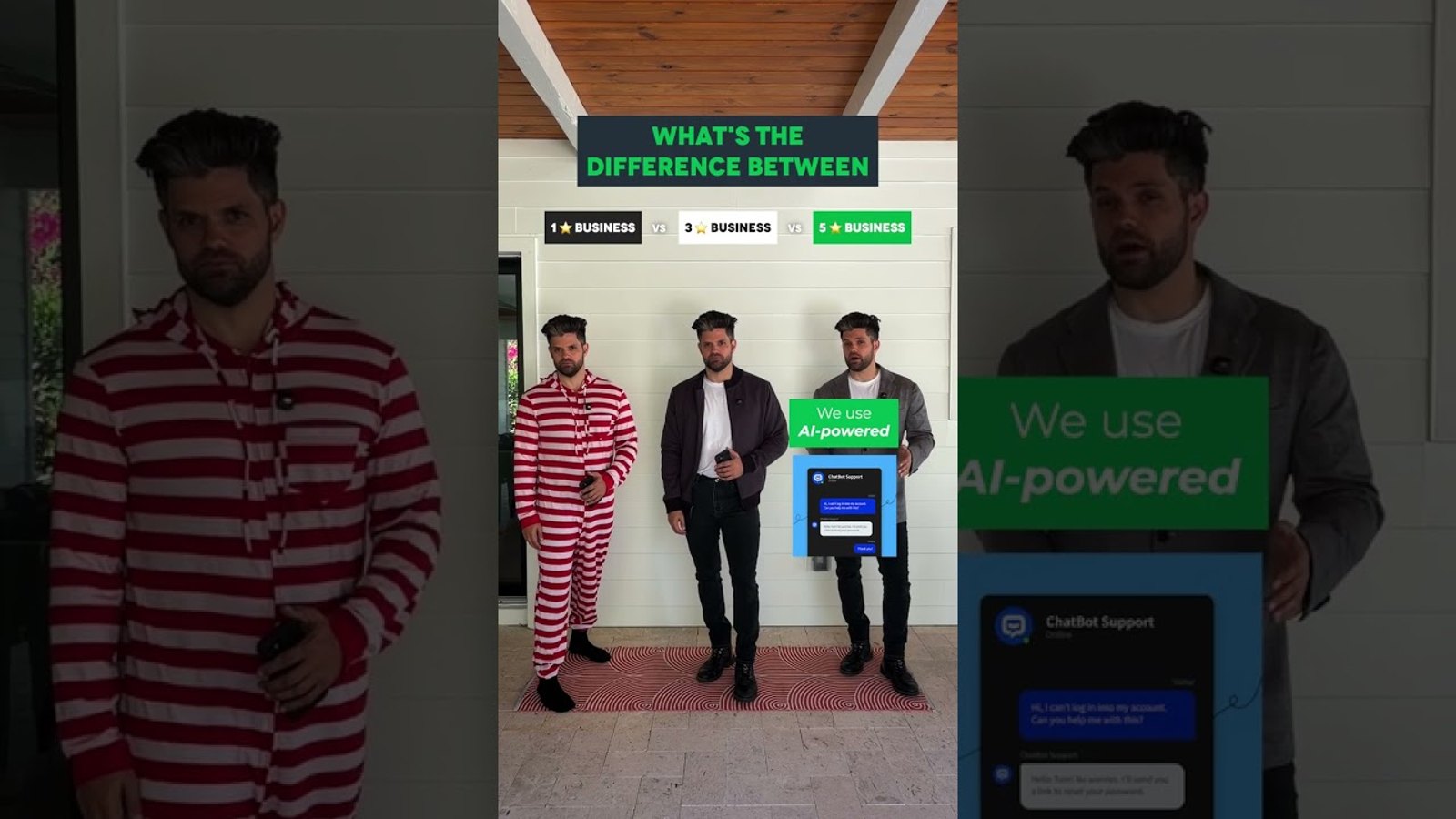
To improve your Google rating, fix what customers experience first, then ask every customer for a review soon after the job. Your review score is an average of every rating, so faster replies, clear prices, and well-timed asks lift it over time. In a short video on what separates a 1-star business from a 5-star business, I show the habits behind each score.
How do I improve my Google rating?
Improve your Google rating by fixing what causes low reviews, then asking every customer while the job is fresh. In my August 2026 study of 216 US markets, the lowest rating on a typical ChatGPT panel was 4.8. Start with the complaints already in your reviews, since they name the fix.
A rating is a lagging number, so it moves after the operation changes. Customers rate the whole job: how fast you answered, whether the price held, and whether anyone explained the work.
Google also says more reviews and positive ratings can help a business's local ranking. Keep a complete Google Business Profile next to that number, because the profile is where most people see your rating first.
The complaints behind a 1-star Google review
Low reviews tend to name the same three things: nobody answered, the bill had surprises, or nobody explained the work. Read your own 1-star and 2-star reviews for those patterns before you change anything else.
My own industry is a fair example. One 1-star Trustpilot review of an agency reads: "Our rep completely stopped responding, we've called, texted, and emailed with no reply."
Another names the bill: "Add a bunch of add-ons you will never use". Both complaints are about how the customer was treated, and both can be fixed inside the business. Neither one needed a better review request to prevent it.
How Google calculates your star rating
Your Google star rating is the average of every rating published on Google for your business. Google's page on review scores says so and uses a scale from 1 to 5 stars. Expect a lag of up to 2 weeks before a new review changes the score.
An average has two practical effects. A business with few reviews swings hard on one bad rating. A business with hundreds of reviews barely moves, up or down.
That is why your next fifty reviews are where the work pays off. The old ones are fixed in the average, and the new ones reflect how you run the business today.
How to improve your Google rating by fixing the experience first
- Answer calls and messages within minutes during business hours, and return every missed call the same day.
- Give the price in writing before the work starts, including anything that could change it.
- Walk the customer through each step of the job, so nothing about the process surprises them.
- Check in when the job ends, and fix anything that went wrong while the customer is still with you.
- Ask every customer for a review that same day, whether the job went perfectly or needed a fix.
- Read each new review for its cause and change the process behind it. My short video covers three review habits that start with fixing the experience.
The habits behind a 1-star and a 5-star Google rating
The 1-star business
Argues with customers in the review section. Misses calls and replies a week later. Leaves the Business Profile without photos or details, then runs ads hoping to cover the rating.
The 3-star business
Apologizes and moves on without fixing the cause. Means to reply within a day but slips when busy. Fills out the profile once and rarely updates it.
The 5-star business
Responds calmly, moves the conversation offline, and fixes the issue. Uses a system so every customer hears back fast. Keeps the profile current with posts, photos, and new reviews.
Response time and your Google star rating
Response time shapes the rating before the work even starts. A customer who waits days for a call back arrives annoyed, and that mood tends to show up in the review.
I tell clients to answer calls and messages within two minutes during business hours. When that is not possible, an automatic text that says when you will call back keeps the customer informed.
Missed calls cost you twice, in lost jobs and in lower ratings. My guide to getting more calls from your Google Business Profile covers the call side. Google's own review tips add that a prompt reply to a review shows customers you value their feedback.
When to ask so your Google rating reflects the work
Ask the same day the job ends, while the customer still remembers how it went. Google's content policy allows asking for genuine reviews but bars pressuring customers on the premises. Send the request by text or email that day, and let them answer on their own time.
A same-day ask reaches the customer while the good parts of the job are still fresh. Weeks later the details have faded, and the request reads like an afterthought.
Ask every customer, including the ones whose job needed a fix. Google's policy also bans asking staff to collect a set number of reviews, so skip review quotas.
Why review gating is not allowed on Google
Review gating means asking only happy customers to review you on Google, and Google does not allow it. Google's policy on rating manipulation says businesses may not "selectively solicit positive reviews from customers". Ask every customer the same way, whatever you expect them to say.
The common version is a survey that asks "How did we do?" and sends only the high scores to Google. The FTC's review guide agrees: "Don't ask for reviews only from customers you think will leave positive ones."
Google's policy also bans discounts, gifts, or payment in exchange for a review, and it removes incentivized reviews. Bought reviews and so-called review generators fall under the same rules. The unhappy customer you do hear from is the one who tells you what to fix.
How many 5-star reviews it takes to move a Google rating
It depends on how many reviews you already have, because Google's review score is a plain average. At 4.2 stars across 50 reviews, reaching 4.5 takes 30 straight 5-star reviews. Run the same math on your own numbers before you set a target.
These are illustrative numbers, not client data. With 20 reviews at 4.8, one 1-star review drops the average to about 4.6. With 200 reviews at 4.8, the same review leaves it at about 4.78.
A small base recovers fast with a steady run of good reviews. A large base needs a long run to move a tenth of a star: at 4.5 across 200 reviews, reaching 4.6 takes 50 straight 5-star reviews.
What a star rating means in ChatGPT's answers
ChatGPT shows star ratings in its local business answers, and the bar is high. In my study of ChatGPT's local answers, the median lowest rating on a panel was 4.8 in every city tier. Use that as a reference point for ChatGPT, not a hard cutoff.
Rating mattered, but it was not the biggest signal. Each extra tenth of a star carried a descriptive odds ratio of 1.36, while an in-city address carried 14.4. That is descriptive, not causal.
Businesses still shown days later had the same 4.9 median rating as those that dropped out. The difference was review depth, at 226 median reviews versus 164. My read of that pattern is in what AI answers reward in local businesses.
Numbers to track while your Google rating climbs
Track a few numbers monthly, so you can see the operation change before the average does. The local SEO metrics that matter give you the wider picture.
-
Your Google star rating and total review count, on the same day each month.
-
New reviews per month, and how many of them are 1-star or 2-star.
-
The most repeated complaint in your low reviews, in the customer's own words.
-
How fast you answer calls and messages during business hours.
-
How fast you reply to new reviews, good and bad.
-
The rating and review count of the businesses that show up for your service.
Improve your Google rating with reputation management
I run reputation management and rankings as one workflow for local and multi-location businesses. Your reviews feed the same work that moves your Google results and AI answers. It starts where this article does, with the reviews you already have and the causes behind them.
Talk to Spearleaf about reputation management
Joshua Albanese is the founder of Spearleaf. He ran the August 2026 study of 216 US markets that measured which star ratings ChatGPT displays.
- How I read the study: what AI answers reward in local businesses.
- Turn views into calls: get more calls from your Google Business Profile.
- Find the gap: why a competitor outranks you on Google.