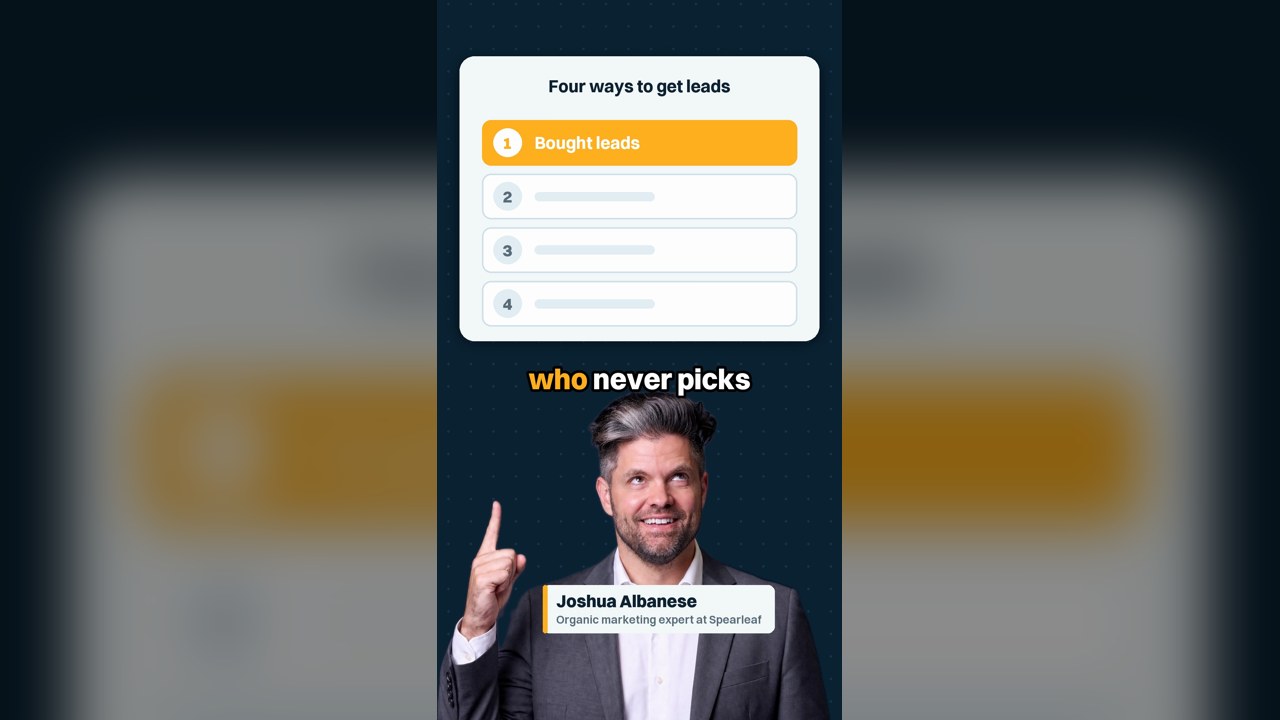
How to get roofing leads comes down to one question: what happens to each source the day you stop paying. In Joshua Albanese's short video on roofing leads, I answer a roofer whose bought leads often never pick up. Bought leads and Google ads fill this month's board, while your Google listing, website, past customers and neighbors keep working in a slow month.
How to get roofing leads that keep coming when you stop paying
Use four sources: bought leads, Google's paid ads, your Google listing and website, and past customers. Google's Local Services Help says your ad stops showing once the monthly max is spent, so paid leads end with the budget. Build the sources you own while the paid ones fill the board.
If word of mouth works but you want more consistent lead flow, sort before you spend. A reviewer of one marketing agency on Trustpilot said the calls its marketing brought were "for things that we did not service".
I run Spearleaf, a national SEO and AI search agency, and I sort lead sources by what is left when the money stops. The sections below cover what each source costs, how fast it works, and the rules that come with it.
Four ways to get roofing leads, sorted by what happens when you stop paying
Bought leads
Fast to start, and you pay for the contact, not the signed roof. Stop paying and the requests stop that day, with nothing carried over.
Google's paid ads
Search ads charge per click, and Local Services Ads charge per lead. These homeowners searched for a roofer themselves, but the calls stop when the budget does.
Your Google listing and website
They cost time up front and take months to bring calls. A slow month does not switch them off, and they give AI answers something to point to.
Past customers and neighbors
No fee, just your time and a habit of asking. These leads don't vanish when the ad budget does.
Bought roofing leads, shared or exclusive, and what to ask a lead seller
A shared lead is sold to more than one roofing company, so you race other roofers to the same homeowner. An exclusive lead goes to you alone, so ask how the seller defines it.
Seller claims can be wrong. In 2023 the FTC alleged HomeAdvisor made misleading claims about the quality and source of the leads it sold. Ask these questions before you buy, and again when contact rates drop:
-
Is each lead shared, and with how many roofing companies?
-
Where did the homeowner fill out the form, and on what date?
-
What consent did the homeowner give to be called or texted by my company, and can I see the record?
-
Is the lead for a repair, a replacement or an insurance claim, and is it inside my service area?
-
What is your credit policy for wrong numbers, duplicates and homeowners who never asked for a roofer?
Speed to lead, and why some bought leads never answer
Calling fast is good practice. Harvard Business Review research from 2011 found "most companies are not responding nearly fast enough". Call every lead the same day, and within the hour when you can.
A homeowner who never picks up isn't always on you, though. If a seller's leads rarely answer even when you call right away, try a different seller or a different source.
Measure it yourself. Log when each lead arrived, when you first called, and whether you reached a person. Compare that contact rate across sellers every month.
Calling and texting roofing leads under the FCC and FTC rules
Speed has rules. The FCC's rule at 47 CFR 64.1200 covers sales calls and texts, and the FTC's Do Not Call guidance covers telemarketing to consumers. Here is what applies to a roofer working leads:
-
Autodialed or prerecorded sales calls and texts to a cell phone need the homeowner's prior express written consent.
-
Written consent is a signed agreement, e-signatures included, that authorizes your company to call that number and says it isn't required to buy.
-
Sales calls to homes are allowed only from 8 a.m. to 9 p.m., the homeowner's local time.
-
Don't make sales calls to numbers on the National Do Not Call Registry unless an exception applies.
-
The FTC says you can call for three months after a homeowner's inquiry, and for 18 months after a purchase.
-
Check the registry at least every 31 days, and keep your own do-not-call list.
-
A homeowner can revoke consent any reasonable way, including replying "stop", and you must honor it within 10 business days.
-
State laws can be stricter, so check your state attorney general's rules before you text or call bought leads.
Google Ads and Local Services Ads for a roofing company
Google's paid ads reach homeowners who searched for a roofer themselves. Search ads charge per click at a price the auction sets, and Local Services Ads charge per valid lead. Both stop when the budget stops.
Roofers are an eligible Local Services category, and Google screens each business before it earns the Google Verified badge. Google's requirements page says screening takes 3 to 4 weeks on average after you submit documents.
Plan for that before storm season. Google's screening page says checks can include background, business registration, insurance and license checks.
Own the Google Ads account behind your roofing leads
The calls stopping when the budget stops is normal for paid ads. What should outlast the spending is the ad account, its search terms and its call data, in your company's name.
Keep yourself as an admin on the account. Google's access help page shows how to add users and remove them later, so an agency never holds the only key. Then next spring starts from what this spring taught you.
Count calls, not clicks. One reviewer of a marketing agency on Trustpilot wrote, "I was getting ALOT of clicks and no calls". My team runs Google Ads management for owners who want help with the setup.
Your Google Business Profile, reviews and roof repair pages
Your listing on Google Maps and your website take months to bring calls, but a slow month doesn't switch them off. Google's help page on local ranking names relevance, distance and prominence, and says more reviews and positive ratings can help.
It also says there's no way to pay for a better local ranking. Write a real page for each service, such as roof repair and roof replacement, and keep your Google Business Profile complete.
Ask every customer for a review, and offer nothing for it. Google's content policy bans review incentives and asking only happy customers. The FTC's 2024 rule also bans fake reviews and rewards tied to a review's sentiment.
What ChatGPT reads before it names a roofing company
ChatGPT reads directories and review sites before it names a roofer. In my August 2026 study, expertise.com was the site ChatGPT cited most for roofing companies, in 6 of 18 markets. Check yours: ask ChatGPT for the best roofing company in your town and note the sites it cites.
Across every service in the same study, angi.com and homeadvisor.com were among the sites ChatGPT read most often. Keep any directory profiles accurate, with the same name, address and phone as your Google listing.
Location mattered too: most businesses ChatGPT showed had an address in the city the question named. Real repair and replacement pages give ChatGPT and Google's AI answers something to point to.
Past customers, neighbors and referrals for roofers
Past customers and the neighbors they send cost no fee, just your time. They also don't vanish when the ad budget does.
Ask for a referral at the final walkthrough, while the new roof is fresh, and leave a yard sign up if the homeowner agrees. Call past customers before storm season to offer an inspection, and ask who else on the street might want one.
If you reward referrals, keep the reward separate from any insurance claim, and ask your attorney about your state's rules. When the past-customer list is long, Spearleaf also runs customer reactivation.
Door knocking for roofing leads, permits and the Cooling-Off Rule
Door knocking after a job or a storm can bring leads, and it comes with local and federal rules. Check your city or county code first. Fort Collins, Colorado, for example, requires a permit for all commercial door-to-door solicitors.
-
Get any solicitor permit your city or county requires before a crew knocks.
-
Knock only in the allowed hours; Fort Collins allows 9 a.m. to sunset.
-
Skip homes with "No Solicitation" or "No Trespassing" signs, as Fort Collins requires.
-
For sales of $25 or more made at the home, the FTC's Cooling-Off Rule gives the homeowner three business days to cancel.
-
Tell the homeowner about that right at the sale, and give two copies of a cancellation form plus the contract.
-
The rule has exceptions, including emergencies and repairs the homeowner asked you to come do, so check with your attorney.
Storm and hail season without the storm-chaser label
Homeowners are told to be wary of storm chasers, the contractors who knock unannounced after bad weather. The FTC's home improvement advice says scammers "knock on your door looking for business because they are 'in the area'". Show homeowners you're local, licensed and insured before they ask.
The same FTC page tells homeowners to confirm a contractor's license and ask for proof of insurance. It also says not to pay the full amount up front. Put your name, address, phone and license number on every contract.
Insurance rules matter in storm work. The Texas Department of Insurance says it's illegal for contractors to waive a deductible or offer rebates or credits in its amount. TDI also says contractors from outside your area can't ask for payment before work starts.
The roofing leads mix, season by season
Usually it's a mix. Paid leads fill this month's board, and the listing and pages mean next year leans on paid leads less.
-
This month: bought leads and Google's paid ads, kept only while they sign roofs at a profit.
-
Before storm season: Local Services screening, a call list of past customers, and permits for any door knocking.
-
After every job: a review request, a referral ask and a yard sign where the homeowner agrees.
-
Every month: one more service page and an updated Google Business Profile.
-
In a year without hail: the listing, the pages and past customers, so you are not leaning on paid leads alone.
Count which source signed the roof
- Add a lead source column to your CRM or a spreadsheet, and fill it in for every lead.
- Ask every homeowner how they found you. One owner on r/smallbusiness put it plainly: "You'd need to ask every customer how they found you".
- Turn on phone call conversions in Google Ads, so calls from ads and your site are counted.
- Check each Local Services lead's charge status, and use the lead survey to flag wrong numbers and poor leads.
- Each month, divide what each source cost by the roofs it signed. That is your cost per signed roof.
- Keep paid sources that sign roofs at a profit, and fix or drop the rest. For more numbers worth tracking, see the local SEO metrics that matter.
Build roofing leads you own, and keep the phone ringing in slow months
My team at Spearleaf runs local SEO for service businesses: the Google Business Profile, reviews, service pages and the AI answers that read them. It builds the sources on this page that keep working when the ad budget stops.
Talk to Spearleaf about local SEO
- Read this first: Google Ads for small business, month one.
- Compare them: local SEO vs Google Ads.
- Then build reviews: how to improve your Google rating.