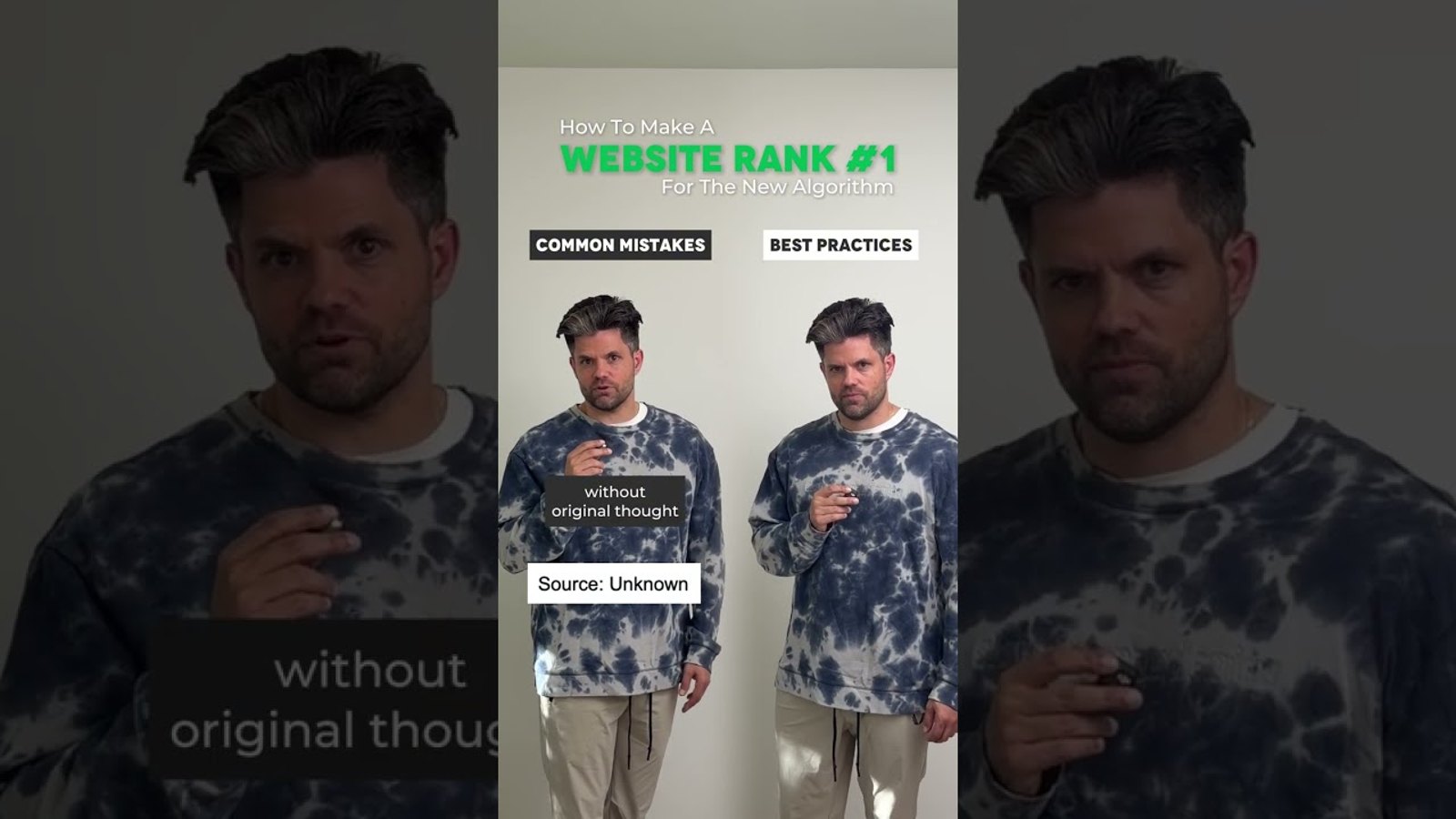
AEO content is a page written so ChatGPT, Google AI Overviews, Perplexity, and Gemini can lift a passage and quote it. The work is clear headings, answer-first paragraphs, short sections, lists and tables, honest dates, and a named author. I compare what gets quoted with what gets skipped in a short video on writing content AI will cite.
What is AEO content?
AEO content is writing built so an answer engine can quote it, one self-contained passage at a time. In the GEO study by Aggarwal and colleagues, adding sources, quotes, and statistics raised visibility in AI answers by 30-40%. Use that as the brief: one question per section, answered plainly and backed by something checkable.
AEO stands for answer engine optimization. It sits in the same family as SEO and GEO, and I cover the difference between SEO, GEO, and AEO in a separate guide. This one stays on the writing.
One owner wrote in a review, "I know nothing about SEO or websites." That's fine here. AEO content is plain writing with a clear shape, and it's the part of AI search an owner can do alone.
How AI answers lift one passage from a page
An AI answer reads several pages for each question and lifts the passage that answers it most cleanly. In my August 2026 study, the websites ChatGPT retrieved for the same question overlapped only 0.20 between two asks (n=197). Write every section so it still makes sense when it is the only part read.
Overlap here means how much of the reading list stayed the same. A score of 1 would mean the same sites both times. A score of 0.20 means the list mostly changed, so ChatGPT may read your page one day and skip it the next.
The old goal, in one owner's words, was help "to make a new website show up in Google searches." Showing up still matters. Now each section of the page also has to work as a quote.
Why short sections beat long keyword posts in AI answers
Short sections that each answer one question are easier for an AI answer to lift than a long keyword post. The same GEO study found keyword stuffing gave little to no improvement in AI answers. Swap the repeated keywords for one short section per question.
The long post with the keyword in every paragraph can still rank on Google. It's hard to quote, though, because no single passage answers anything by itself. AI answers want the passage, and the passage has to stand alone.
My short video on how to show up in AI results trades long keyword posts for short answers.
Headings that tell ChatGPT what each section covers
A heading should name the one thing its section answers, so ChatGPT and a skimming reader both know what follows. Nielsen Norman Group's 1997 research on web reading found 79% of test users scanned a new page, and only 16% read word by word.
Write each heading as a plain label or a real question that names the service. A heading like "Water heater repair cost" tells an answer engine far more than "Our approach" does. Then read only the headings and check that the page still makes sense.
A plugin that "gives a clear red amber green icon for each post as you write it" won one owner over. For a 40-second version of these checks, watch my short video on formatting content for AI.
The three-sentence block AI answers can quote
This is the pattern I use under every heading. It keeps each passage short enough to lift and complete enough to trust.
- State the answer. Open with one sentence that answers the heading, with no warm-up.
- Back it with something checkable. Add a number, a named source, or what you saw on a real job.
- Tell the reader what to do. End with one action that starts with a verb.
- Stop at about 50 words. If the block needs more, the heading is covering two questions, so split it.
Plain specific wording that AI answers can reuse
Swap adjectives for facts, because a fact can be quoted and an adjective can't. "Quality service" says nothing. "Same-day repairs on most tank water heaters" says something a customer can act on.
Nielsen Norman Group found readers disliked boastful marketing copy, which it calls marketese. In the same research, concise text scored 58% better on usability and scannable text 47% better.
Name things the way your customers do, and define a trade term once in plain words. Use numbers where you have them, such as hours, years, prices you publish, or how many jobs you finished last year.
Lists and tables that AI Overviews can read
Match the format to the shape of the answer, so the passage keeps its meaning when AI Overviews or ChatGPT lift it.
Use a list for steps or options
Use a numbered list when order matters and bullets when it does not. Keep each item to one line and start each one the same way.
Use a table for comparisons
Use a table when the reader compares two or more things on the same points, such as time, materials, or warranty. Put the labels in the first row.
Use a paragraph for reasons
Use two or three sentences when the answer is a why. A list strips out the because, and the because is what makes it worth quoting.
A before and after rewrite of AEO content
Here is one section of a made-up plumber's service page, rewritten as AEO content.
Before with a generic heading
Under "Our plumbing services": We have proudly served the community for over 20 years, and your satisfaction is our top priority.
After with a question heading
Under "How long does a water heater swap take?": On our jobs, a tank swap takes about three hours. Tankless takes longer because of venting, so book a morning slot.
What changed
The heading now names the question. The first sentence answers it, the second covers the exception, and the last gives a next step.
Keeping AEO content fresh without faking the date
Fresh AEO content means the facts changed first and the date changed second. It doesn't mean a new date on old facts. Google's guide to helpful content asks whether you change dates to make pages seem fresh when the content has not substantially changed.
Set a review rhythm for the pages that answer buying questions. Check timelines, service areas, prices you publish, and every number you cite. Then update the visible "last updated" date and note what changed.
In the video linked at the top, I say I update content every 30 days. That's my habit. No AI company has published a refresh rule, so pick a rhythm you'll keep.
Author and E-E-A-T signals on pages AI answers read
Put a real name, a real role, and first-hand detail on every page you want quoted. Google's helpful content guide asks whether pages carry a byline and whether it leads to background on the author.
E-E-A-T stands for experience, expertise, authoritativeness, and trust. Google says E-E-A-T isn't a ranking factor by itself, so treat it as what a careful reader checks. Never invent an author or a credential.
Add what only you know: the job count, the odd case, the mistake you stopped making. For a short version, watch my video on E-E-A-T content for AI, which contrasts keyword stuffing with expertise and credentials.
How to check whether AI answers quote your page
Ask the engines the question your page answers, then see which source they quote. In my study, only 34.1% of markets kept the same number one business between two asks (73/214). Check monthly, because one result tells you little.
- Pick the one question the page answers, worded the way a customer would type it.
- Ask ChatGPT, Perplexity, and Google, and note which sites each one cites.
- Read the passage they quoted, yours or a competitor's, and compare its shape with yours.
- Rewrite the section that should have answered, then log the date and the change.
- Repeat monthly and keep what moved. My video on how I would rank a business starting over ends on this monthly check-in.
A one-page template for answer engines
Use this layout for any page you want answer engines to quote. With dozens of pages to rework, a content strategy decides which ones come first.
-
A heading that names the question, or the service and the place.
-
A first paragraph that answers it in under 50 words.
-
One subheading per follow-up question, each opening with its answer.
-
A list for steps, a table for comparisons, a short paragraph for reasons.
-
At least one number with a named source, or your own job data.
-
A byline that links to an author page with real background.
-
A visible "last updated" date that changes only when the facts do.
-
A short FAQ for the questions that did not earn their own section.
Get your pages quoted by ChatGPT and AI Overviews
I run AI search optimization for businesses that want ChatGPT, Gemini, Google's AI, and Perplexity to quote and recommend them. The writing in this guide is where that work starts on every page.
Talk to Spearleaf about AI search optimization
Joshua Albanese is the founder of Spearleaf. He ran the August 2026 study of ChatGPT answers across 216 US markets that this guide draws on.
- Compare all three: SEO vs GEO vs AEO for a local business.
- See how each one picks: ChatGPT vs Google.
- How I read the study: what AI answers reward in local businesses.