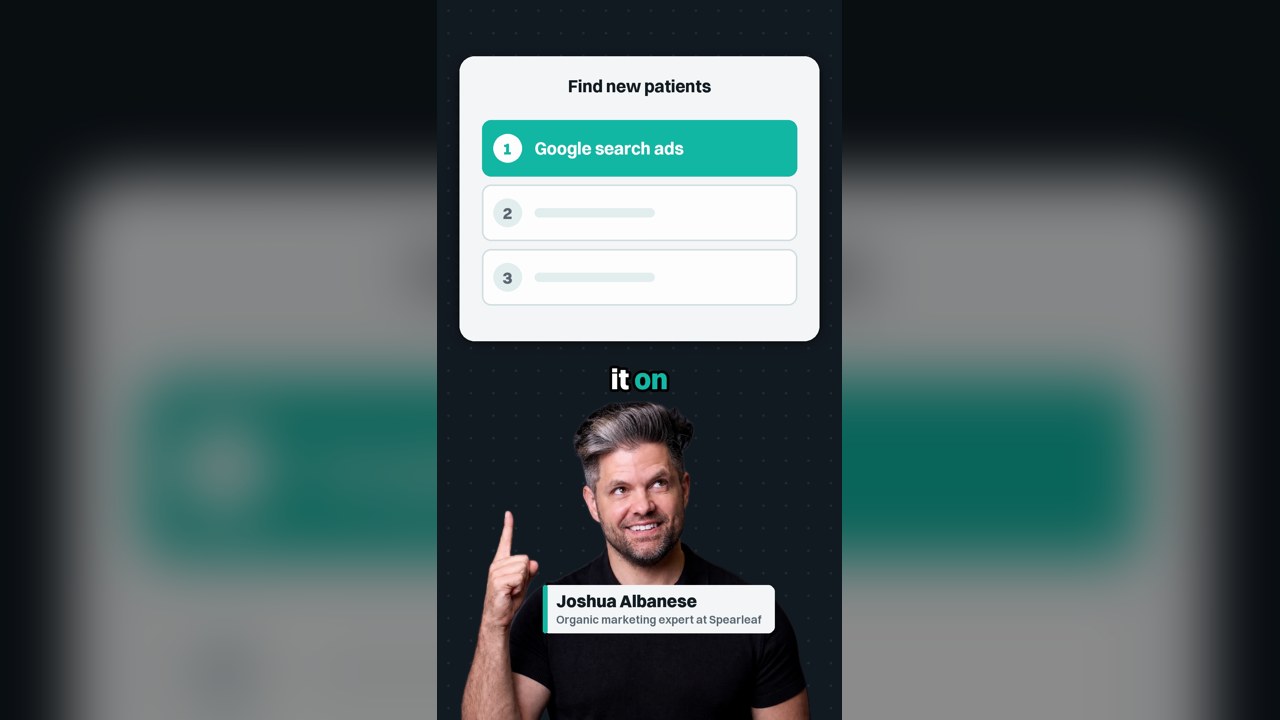
Healthcare digital marketing strategies work best picked by your practice's gap: empty new-patient slots, or patients who stop before they finish. I'm Joshua Albanese, and my short video on digital marketing for healthcare sorts five channels by how fast each one gets going. Search ads launch quickly to reach new prospects, email reaches your own patients right away, and listings and pages build over months.
Which healthcare digital marketing strategies fit your practice?
Pick by your gap: empty new-patient slots point to search ads first, and patients who drop off point to email first. Google says most ads are reviewed within one business day, so search ads can launch quickly. Plan around demand, your offer and your intake, because those set the time to a booked patient.
Healthcare digital marketing is the online work that brings patients in and brings them back. Word of mouth works, but you may want more consistent lead flow and need help getting found online. One owner on r/smallbusiness summed up tactic lists: "Sorry, just feeling quite overwhelmed by all this info!"
I run Spearleaf, a national SEO and AI search agency, so I sort the options by speed. Most practices have both gaps, so treat the order as a starting point.
Five digital marketing channels for healthcare, sorted by speed
Google search ads
Quick to launch and aimed at new prospects. Most ads clear Google's ad review within one business day. You pay for every click, whether or not anyone books.
Your listing on Google
An afternoon to fix the category, hours and photos. Moving up the map takes weeks or longer, and steady reviews do much of that work.
Website pages for each problem
One page per problem patients search, such as rotator cuff rehab or dental implants. Pages take months to show up, and AI answers read them too.
Email to your own patients
Reaches patients you already have right away, once the right agreements are signed. It costs little beyond the time to write it.
Social media
Slow to build. It earns trust over months: a physical therapist showing an exercise, or a dentist explaining a crown.
Google search ads launch quickly and reach new patients
Search ads reach a patient who is searching right now. A physical therapy clinic with open evaluation slots can run one for knee pain near the clinic. You pay for every click, whether or not anyone books.
Google's help page on actual cost per click says the ad auction sets the final price, often below your maximum bid. One reviewer of a marketing agency described the risk plainly: "I was getting ALOT of clicks and no calls".
Before you turn ads on, make sure someone answers the number in the ad during clinic hours. Then count which calls became booked visits. My team runs Google Ads management when you want help with the setup.
Health ad rules on Google Ads and Meta for a practice
Health ads carry extra rules on both platforms, and they limit who you can target. Check these before you build a campaign:
-
Google's healthcare ad policy requires certification for recovery-oriented drug and alcohol addiction services.
-
The same policy makes online prescribing services, including telemedicine providers that prescribe, apply before they advertise.
-
Google's health in personalized advertising policy and its personalized ads policy treat health as a sensitive category.
-
Ads in restricted health categories can't use personalized audience targeting, such as your patient lists, so plan on keywords and location.
-
Meta removed detailed targeting tied to health causes, such as "Chemotherapy", starting January 19, 2022.
-
Google Ads can record calls from ads, and Google's call reporting page says you can turn recording off. Turn it off unless your attorney approves it.
Fix your Google Business Profile, then keep patient reviews coming
Fixing your Google Business Profile takes an afternoon, and moving up the map takes weeks or longer. Google's local ranking page names relevance, distance and prominence (popularity, in its current wording), and says more reviews and positive ratings can help. Set the right category, true hours and real photos, or have my team handle Google Business Profile optimization.
Doctors and dentists count as individual practitioners under Google's profile guidelines. With several practitioners at one address, the practice keeps its own profile, and each public-facing practitioner may have one too. Google says a solo practitioner at a branded practice should share one profile, named brand first, then practitioner.
Where your professional code permits review requests, ask in a consistent way, without incentives or screening for satisfaction. Mental health professionals must check their code first. Google's policy bans all review incentives and asking only happy patients.
How to reply to patient reviews without breaking HIPAA
Reply in general words that reveal nothing about the patient, even when the reviewer shared details. ADA News reported in March 2025 that disclosing patient information in a reply can bring legal action and fines. Use these rules for every reply, or hand them to your reputation management partner:
-
Never confirm or deny that the reviewer is a patient, even in a thank-you.
-
Leave out names, dates, conditions, treatments, insurance and visit details.
-
Thank positive reviewers in general words about your team and practice.
-
Invite anyone with a complaint to call the practice manager directly.
-
Have one trained person write replies, and ask your attorney about any that feel risky.
Website pages for each problem patients search
Give each problem patients search its own page: a PT clinic writes one for rotator cuff rehab, a dental office one for implants. Each page describes the visit and the plan of care, not a result. Plan on months, not weeks, before a new page shows up in search.
Claims about results carry rules. The FTC's advertising guide for small businesses says health claims generally need competent and reliable scientific evidence, and testimonials usually are not enough. Your licensing board may add its own advertising rules, so check them before you publish.
Build pages that load fast on a phone and read cleanly with a screen reader. My team builds these pages through web design and content strategy.
Tracking pixels and HIPAA on a healthcare practice website
Ad pixels and analytics tags can send what a visitor does on your site to Google or Meta. On a practice website, that can include patient information, so check every tag:
-
Keep ad pixels and analytics tags off logged-in pages, such as a patient portal, and off appointment requests and intake forms.
-
Google says it offers no business associate agreement for Google Analytics, and HIPAA-covered pages should not carry its tags.
-
In June 2024, a federal court vacated one part of HHS's tracking guidance: IP addresses tied to public pages about conditions or providers.
-
The court wrote that its ruling does not limit the rest of that guidance, and HIPAA still covers patient information.
-
HHS dropped its appeal in August 2024, per the American Hospital Association.
-
Ask your web developer for a list of every tag on the site, and review it with your attorney.
What ChatGPT and Google's AI say when patients look for a practice
ChatGPT names a short list of practices and leans on review and directory sites to build it. In my August 2026 study, ChatGPT cited psychologytoday.com in all 18 therapist markets. Check yours by asking ChatGPT and Google's AI for a PT clinic for shoulder rehab in your town.
24 of the 71 chiropractor ratings ChatGPT showed that traced to one platform were Yelp's. The site ChatGPT cited most for dentists was reviews.birdeye.com, in 9 of 18 markets. It also led for chiropractors, in 8 of 18.
Google's AI Overview fired on 15.3% of dentist questions and 13.9% of therapist questions. Your pages, listings and reviews are what these tools read, which is the work of AI search optimization.
Email to your own patients brings them back
Email reaches patients who already chose you, and it costs little beyond the time to write it. A PT clinic can email past patients when it adds early morning evals, with the link to book. A dental office can do the same for patients overdue for a cleaning.
Under HIPAA's marketing definition, a note about your own health services generally is not "marketing" unless a third party pays you to send it. An email service that holds patient information for you needs a written agreement, per 45 CFR 164.502(e). Ask your lawyer what your email service needs to sign.
Promotional email also falls under the FTC's CAN-SPAM rules: include your postal address and an opt-out, and honor opt-outs within 10 business days.
Social media builds trust for a practice over months
Social media is the slowest channel to book anyone, and it builds trust over months. A physical therapist showing an exercise, or a dentist explaining a crown, gives patients a feel for the practice. Post short videos that teach one thing.
The AMA's ethics opinion on social media tells physicians not to publish patient information online without appropriate consent. It also asks them to disclose financial interests tied to their posts. Get signed consent before any patient appears in a photo or video.
Choose healthcare digital marketing strategies by your gap
Usually the answer is a mix, ordered by your gap. Treat these as a starting order, and adjust when both gaps show up at once:
-
Empty new-patient slots call for search ads now, with the listing and pages built for later.
-
Patients dropping off before they finish call for email to your own list first, before you pay for new clicks.
-
Otherwise your new patients just refill the spots the dropouts leave.
-
With both gaps, start the patient emails this week and the ads once every call gets answered.
-
A new practice with no patient list starts with the Google listing and search ads.
-
Social media runs alongside all of these, as the slow build.
How to track new patients by channel in your practice
- Add a "where did you hear about us" line to the intake form, and have the front desk ask it at booking.
- Record each answer in your practice software's referral source field, so you can count it by month.
- Check your Business Profile performance report monthly for calls, website clicks and direction requests.
- Turn on call reporting in Google Ads, so calls from ads count as conversions, with recording off.
- Put a booking link in every patient email, and count the bookings that came through it.
- Count new patients by channel each month, and how many came back to finish their plan of care.
Get found by patients on Google Maps and in AI answers
My team at Spearleaf runs local SEO for practices: the Google Business Profile, reviews, service pages and the AI answers that read them. It fits once your phones are answered and your tracking is in place.
Talk to Spearleaf about local SEO
- How each picks a business: ChatGPT vs Google for a local business.
- Read this first: Google Ads for small business, month one.
- Then track it: local SEO metrics that matter.