
Local SEO is the practice of getting your business found by nearby customers the moment they search for what you offer, whether that is "electrician near me" or "best coffee in town." It works by strengthening the signals Google and AI use to rank local businesses, and it is exactly what our local SEO program is built around, so the people close enough to become customers actually see you first.

What does local SEO actually mean?
Local SEO is search engine optimization aimed at a place. It is the work of showing up when someone nearby searches for a business like yours.
Regular SEO is a national or global game. If you sell software or ship products across the country, you are competing with everyone, everywhere, and your physical location barely matters. Local SEO is different. When someone searches "plumber near me" or "dentist in Fort Myers," Google reads that as a local search and shows a different kind of result: a map with a short list of nearby businesses, followed by local organic listings. Local SEO is how you earn a spot on that list.
The reason it matters so much for service businesses is intent. Someone typing "emergency plumber" is not browsing; they are ready to call. Local SEO puts you in front of that person at the exact moment they are looking for what you do, in the area you actually serve. You are not paying for their attention the way you would with ads, and you are not competing against the whole internet, only the businesses close enough to be real alternatives.
It also matches how people actually search now. A large share of local searches happen on a phone, often with "near me" attached, and many end in a call or a visit the same day. That behavior is a gift to small businesses: it means a well-optimized profile and a handful of strong service pages can compete with a much larger company that has ignored the local layer. Being the closest, most complete, best-reviewed option for a specific search is often more valuable than being the biggest name in the category.
Why is local SEO different from regular SEO?
The big difference is a whole layer national SEO does not have: your Google Business Profile and the Map Pack.
In regular SEO, the goal is to rank a web page in the standard list of blue links. In local SEO, the most valuable real estate is the Map Pack, the block of three business listings with a map that sits above everything else. Ranking there does not depend only on your website. It depends heavily on your Google Business Profile, your reviews, your proximity to the searcher, and how consistent your business information is across the web. Those are levers national SEO simply does not use.
That is why a business can have a beautiful website and still be invisible locally, or rank in the Map Pack with barely any website at all. The two disciplines overlap, but local SEO adds the profile-and-proximity layer on top. If you have ever wondered why your site ranks fine for a broad term but you cannot be found for a "near me" search, this layer is the answer. Our post on why your business might not be showing up on Google walks through the specific ways that layer can break.
How does local SEO actually work?
Google decides local rankings using three named factors, and everything in local SEO ladders up to one of them.
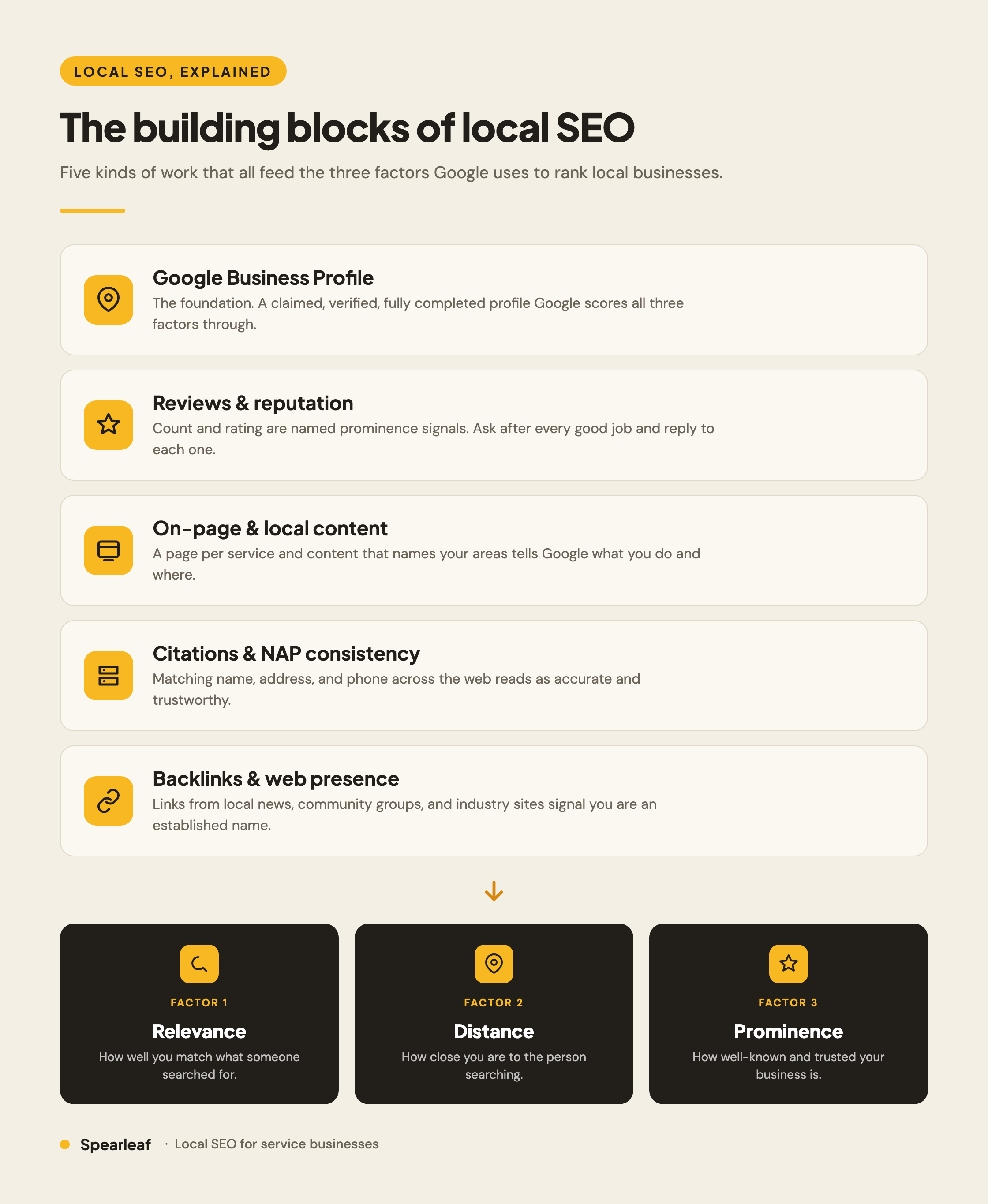
Google publicly names its three local ranking factors as relevance, distance, and prominence. Relevance is how well your business matches the search, which you shape through your categories, your services, and your content. Distance is how close you are to the searcher, which you influence by setting your address and service area correctly. Prominence is how well-known and trusted your business is, built through reviews, links, and a complete web presence. You cannot see Google's exact formula, and anyone claiming precise weights is guessing, but you can build directly toward all three. Our Map Pack ranking factors guide unpacks each one in detail.
AI search runs on a parallel track, and the encouraging part is that it rewards the same work. When someone asks ChatGPT or reads a Google AI Overview for a local recommendation, those systems lean on verified profiles, consistent information, genuine reviews, and authoritative content, the very signals local SEO produces. Do the fundamentals well and you move on both surfaces at once, which is why we treat AI search optimization as part of the same effort rather than a separate project.
What are the main pieces of local SEO?
Local SEO is not one task; it is a handful of moving parts that reinforce each other. Here are the pieces that do the heavy lifting.
Your Google Business Profile
This is the foundation. Your profile is the asset Google scores all three local factors through, so a claimed, verified, and fully completed profile is non-negotiable. That means an accurate primary category, complete hours and services, real photos, and a proper address or service-area setup. Getting this right is usually the single highest-impact move an owner can make, and it is where Google Business Profile optimization always starts.
Reviews and reputation
Review count and rating are prominence signals Google names directly, and they are what a nervous customer checks before calling. The work is a habit: ask happy customers for a review right after a good experience, make it easy with a direct link, and respond to every one. Never buy reviews or fake them, which puts your whole profile at risk. Our guide on getting more Google reviews covers the system.
On-page and local content
Your website feeds relevance. A dedicated page for each core service, plus content that names the areas you serve, tells Google exactly what you do and where. Thin, one-page sites give Google almost nothing to match; real service pages close the gap. The fundamentals here live in our on-page SEO checklist.
Citations and NAP consistency
A citation is your business information listed on sites like Yelp, Facebook, and the Better Business Bureau. When your name, address, and phone match everywhere, Google reads your information as accurate and trustworthy. When they conflict, that noise works against you. Pick one exact format and use it everywhere.
Backlinks and web presence
Google names how many websites link to you as a prominence signal. Local links from news sites, community organizations, and industry associations tell Google you are an established part of your area. Quality and local relevance matter far more than volume here.
Is local SEO worth it for a small business?
For most local service businesses, local SEO is one of the highest-return investments available, because it builds an asset you own rather than attention you rent.
The math is different from advertising. With ads, you pay for every click, and the leads stop the moment you pause the budget. Local SEO costs more up front and little per lead once your rankings are in place, so your effective cost per lead falls the longer the program runs. To be clear, that is the shape of the curve, not a promised number, since real results depend on your market, competition, and how consistently the work gets done. We break down that tradeoff honestly in our comparison of SEO versus Google Ads cost per lead.
Worth it does not mean instant. Local SEO compounds, so the early months carry most of the effort and the later months collect most of the reward. It also is not a set-it-and-forget-it project; reviews, content, and citations need ongoing attention. But for a business that serves a defined area and wants a steady, lower-cost flow of the right customers, few investments pay back like being the business Google shows first.
One more thing worth saying plainly: local SEO does not require a big budget to start, and it does not require you to game anything. The entire discipline rewards businesses for being genuinely good and genuinely findable. Complete your profile, earn honest reviews, keep your information accurate, and describe your services clearly, and you are doing the work Google and AI both want to reward. There are no tricks that beat consistent fundamentals, which is the most encouraging news for any owner who felt like search was rigged against them. It is not. It is a game of doing the basics well, longer than your competitors do.
The questions we hear most from owners trying to understand local SEO, answered plainly.
Ready to be the local business customers find first?
Local SEO comes down to a clear set of fundamentals: a complete Google Business Profile, a steady stream of real reviews, service pages that tell Google what you do, consistent information across the web, and links from your community. Do them well and you show up for the nearby customers already searching, on both Google's Map Pack and the new AI answers. If you would rather have a team build and maintain all of it in the right order, our local SEO program is designed to grow durable lead flow for service businesses, with no long contract, just the fundamentals executed consistently.
This article was written by Joshua Albanese, founder of Spearleaf, a local SEO and marketing agency based in Fort Myers, Florida. Joshua has built six businesses from zero using organic search and content, and he leads Spearleaf's SEO, AI search, and local strategy for service businesses across the U.S.