
If you searched your own business name and came up empty, the cause is almost always one of a short list of fixable problems: an unverified or suspended profile, missing information, a duplicate listing, or simply strong competition you have not out-signaled yet. The good news is that local visibility is largely within your control, and our local SEO program is built to work through exactly these issues in order, so you stop being invisible to the customers already searching for what you do.
Why can't I find my own business on Google?
The first thing to know is that "I can't find my business" and "customers can't find my business" are two different problems, and they have opposite fixes.
When you search your own name, Google personalizes the results around you. It knows your account, your location, and your history, so it often surfaces your listing even when that listing does not rank for anyone else. That is why an owner can see their business perfectly while a customer two neighborhoods over sees only competitors. Before you diagnose anything, look at the real picture: search from a phone that is not signed into your Google account, or open an incognito window and set your location to a nearby area. What you see there is what your customers see.
If your business still shows up cleanly in that neutral view, congratulations, you rank, and your job is to climb higher. If it vanishes, you have a genuine visibility problem. The nine reasons below cover almost every case we see, roughly in the order worth checking them.
Reason 1: Your Google Business Profile is not verified
The most common reason a local business is invisible is the simplest: the profile was never claimed and verified.
Your Google Business Profile is the asset Google uses to rank you in the Map Pack, the block of three listings that sits above the regular results. An unverified profile sits outside the ranking pool entirely, so no amount of website work will pull you in until it is claimed. Search your business name plus your city on Google. If you see a listing with a "Claim this business" or "Own this business?" link, that is your fix. Claim it, complete Google's verification, and you have cleared step zero.
If no listing exists at all, you may need to create one from scratch. Either way, verification is the foundation. Everything else in this list assumes a verified profile is in place, which is why Google Business Profile optimization is where nearly every local visibility project starts.
Reason 2: Your profile is incomplete or your categories are wrong
A verified but half-finished profile ranks like a half-finished profile. Google can only match you to searches it understands.
The single biggest lever here is your primary category. It is the strongest relevance signal Google reads, and owners get it wrong constantly. "Plumber" will outrank "Home Services Company" for plumbing searches every time, because the specific category tells Google exactly what you do. Set your primary category as precisely as possible, then add secondary categories for your other real services. From there, fill in everything: hours, service area, services list, a real description, and photos. Each field you complete gives Google another reason to show you.
Incomplete profiles also lose on trust. A listing with no photos, no hours, and a blank description reads as abandoned, both to Google and to the customer deciding whether to call. Our Map Pack ranking factors guide breaks down exactly which fields feed which of Google's three ranking factors.
Reason 3: Your address or service area is set up wrong
Google is strict about address rules, and getting them wrong can hide you or get you suspended outright.
If you serve customers at your location, like a med spa or a dental office, you need a real, staffed address that matches your signage. If you travel to customers, like a plumber or a mobile detailer, you are a service-area business, and Google wants you to hide your address and instead define the cities you serve. Listing a home address you do not want public, or a UPS box, or a coworking space you do not actually staff, are all guideline violations that can trigger a suspension.
The other trap is inconsistency. If your address on Google does not match the address on your website and your other listings, Google gets a muddled signal about where you actually are, and muddled signals rank poorly. Pick one exact format for your name, address, and phone, and use it everywhere.
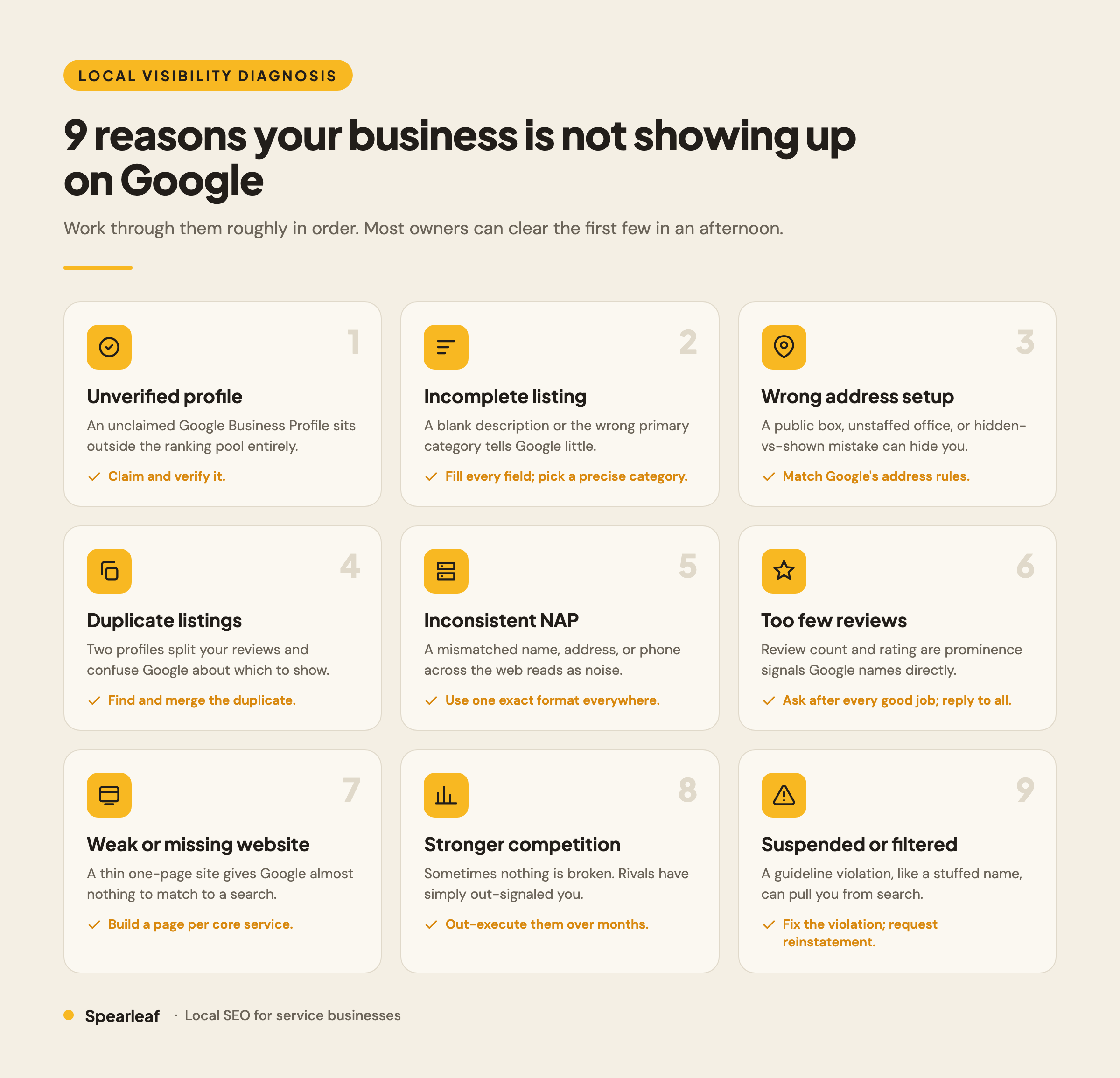
Reason 4: A duplicate listing is splitting your signals
Two listings for the same business is a quiet killer. It divides your reviews, confuses Google, and can leave neither version ranking.
Duplicates happen more often than owners expect. A previous marketer created one, Google auto-generated one from public data, or you accidentally made a second while trying to claim the first. When two listings compete for the same business, your reviews and signals scatter across both, and Google may show the weaker one or filter you out to avoid clutter. Search your business name, your phone number, and old addresses to hunt for stray copies. When you find a duplicate, you can report it through Google so the listings get merged or the extra one removed, consolidating all your hard-earned signals into a single strong profile.
Reason 5: Your name, address, and phone are inconsistent online
Google cross-checks the business details it finds across the web. When those details disagree, your credibility, and your ranking, take a hit.
These listings are called citations: your business information on Yelp, Facebook, the Better Business Bureau, and industry directories. Consistent details across all of them tell Google your information is accurate and trustworthy. Inconsistent details, an old phone number here, a former suite number there, a "Co." that is a "Company" somewhere else, create noise that works against you. This problem is especially common after a move or a rebrand, when the old information lingers on dozens of sites you forgot existed. Clean up the major citations first, keep them matching your Google profile exactly, and the noise fades.
Reason 6: You have too few reviews, or you stopped getting them
Reviews are not just social proof for customers. Review count and rating are signals Google names directly, and a thin review profile holds you back.
Google lists both how many reviews you have and whether they are positive as prominence signals, one of its three local ranking factors. A business with a steady flow of recent, genuine reviews reads as active and trusted; a business with three reviews from two years ago reads as dormant. The fix is a habit, not a hack: ask every satisfied customer for a review right after a good experience, make it easy with a direct link, and respond to every review you get. What you should never do is buy reviews or use a service that fabricates them, which violates Google's policies and risks your whole profile. Our guide on how to get more Google reviews lays out a system that stays on the right side of the rules.
Reason 7: Your website is weak, thin, or missing
You can rank in the Map Pack without a website, but a weak site caps how high you climb, especially for the organic results below the map.
Your website feeds Google relevance signals your profile cannot: a dedicated page for each core service, content that names the areas you serve, and the technical health that lets Google crawl and understand you. A one-page site with a phone number and nothing else gives Google almost nothing to match against a specific search. If your pages are thin, slow, or missing entirely, you are leaning on your profile alone, which only takes you so far in a competitive market. Building out real service pages is often what separates the businesses stuck on the second screen from the ones in the pack. If your site exists but the phone still is not ringing, our post on why your website is not getting calls covers the conversion side of the problem.
Reason 8: The competition is simply stronger than you, for now
Sometimes nothing is broken. You are showing up, just not high enough to be seen, because established competitors have out-signaled you.
Local search is a ranking, not a pass or fail. The businesses above you in a crowded category usually got there by doing the fundamentals longer: more reviews, more complete profiles, more local content, more links from other sites. This is the reason that has no overnight fix, and the one dishonest agencies gloss over. Closing the gap is a matter of consistent execution over months, not a single switch. It is also why SEO takes the time it does: you are compounding trust signals until you overtake the incumbents. Frustrating, but fixable, and durable once you get there.
Reason 9: Your profile was suspended or filtered
If your listing was live and then vanished, a suspension or filter is the likely culprit, and it needs a specific fix.
Google suspends profiles for guideline violations: keyword-stuffing your business name (adding "Best Fort Myers Plumber" to what should just be your name), using an ineligible address, or other policy breaches. A suspended profile disappears from search until you correct the violation and pass reinstatement. Separately, Google sometimes filters a listing that looks too similar to another nearby business sharing an address or phone. If you suspect a suspension, log into your profile to check its status, fix any obvious violation, and request reinstatement. This is the reason we most want owners to avoid by keeping their profile clean from the start, rather than fixing after the fact.
The questions we hear most from owners who cannot find their own business on Google, answered plainly.
Ready to become the business Google actually shows?
Being invisible on Google is rarely a mystery once you work through the list: verify the profile, complete it, fix the address, kill duplicates, clean the citations, grow reviews, strengthen the site, and out-signal the competition over time. Most owners can clear the first few themselves in an afternoon. The rest is the compounding work that turns a listing into a ranking. If you would rather have a team run the whole diagnosis and fix it in the right order, our local SEO program does exactly that, no long contract, just the fundamentals executed consistently until the phone rings.
This article was written by Joshua Albanese, founder of Spearleaf, a local SEO and marketing agency based in Fort Myers, Florida. Joshua has built six businesses from zero using organic search and content, and he leads Spearleaf's SEO, AI search, and local strategy for service businesses across the U.S.