
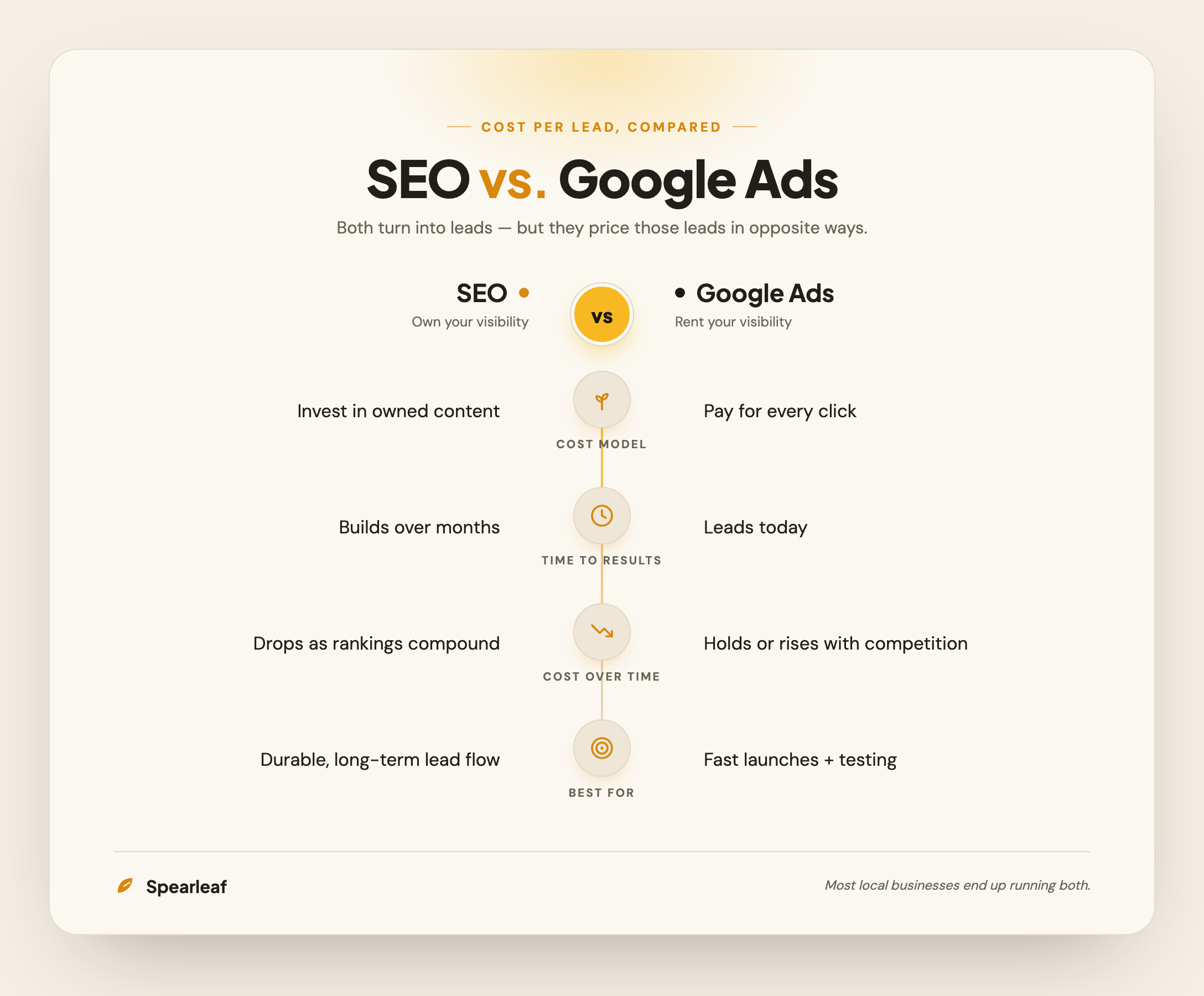
SEO and Google Ads both turn into leads, but they price those leads in opposite ways: ads charge you for every click, while SEO asks for an up-front investment that gets cheaper per lead the longer it runs. For most local businesses, the honest answer to "which is cheaper" is that ads win on day one and SEO wins over time, which is exactly why our SEO and AI search program is built to run alongside paid search rather than replace it.

What is the honest answer on cost per lead?
The honest answer is that neither channel is universally cheaper. They are cheaper at different times, and the right question is not "which one" but "which one when."
Google Ads has a low cost to start and a fixed cost per lead that never really goes away. You pay for each click, so the moment you pause the budget, the leads stop. SEO flips that math. It costs more before it produces anything, but once your pages rank, additional leads arrive at close to zero marginal cost. You are no longer paying per click; you are collecting on an asset you already built.
That is why comparing a single month of ads to a single month of SEO is misleading. Ads look cheaper in month one and SEO looks cheaper in month twelve. Below we break down the two cost models, how they behave over time, and how to choose, all from the perspective of an organic-first agency that still runs plenty of paid campaigns.
How does the cost model differ?
The core difference is ownership. With Google Ads you rent your position at the top of the results; with SEO you earn and own it.
Google Ads is a pay-per-click model. You bid against competitors for a spot above the organic results, and you pay each time someone clicks. Per Google's own description of how Search ads work, you set a budget and pay for results such as clicks to your site. That means cost is predictable and instant, but also perpetual. Your cost per lead is roughly your cost per click divided by your conversion rate, and it holds steady for as long as you run the campaign.
SEO is an owned-asset model. Instead of paying for placement, you invest in the things Google rewards: helpful content, a fast and well-structured site, a complete Google Business Profile, reviews, and links. Those assets keep working after you build them. Our local SEO services focus on the signals that move service businesses into the Map Pack, where the searchers are already in "who do I call" mode. The up-front cost is higher, but you are not renting the result month after month.
One model bills you per click, forever. The other asks for investment now in exchange for leads that get cheaper later. That single distinction drives almost everything else in this comparison.
How fast does each produce leads?
Speed is where Google Ads clearly wins, and it is the most common reason businesses start there.
A paid campaign can produce leads the same day it goes live. You write the ads, set the budget, and you are in front of buyers within hours. That immediacy is genuinely valuable when you have a slow season to fill, a new location to launch, or a cash-flow gap that will not wait for rankings to build.
SEO is slower by nature. Search engines need time to crawl, index, and trust new pages, and competitive terms take longer than quiet ones. For most local service businesses, meaningful organic traction builds over a few months rather than a few days, with the curve steepening as pages mature. If you want a fuller picture of that timeline, our Google Ads management page explains how we use paid search to carry lead flow while the organic side compounds underneath. The point is not that SEO is slow and bad; it is that SEO is slow and durable, and ads are fast and rented.
What happens to cost per lead over time?
This is the row that changes the whole decision, and it is the one most single-month comparisons hide.
With Google Ads, your cost per lead tends to hold steady or drift upward. As more competitors enter your market and bid on the same terms, clicks get more expensive, not less. You can improve quality scores and tighten targeting to keep costs in check, but the underlying model never lets a lead become free. You are always one paused budget away from zero leads.
With SEO, the trend runs the other way. As your pages earn rankings, links, and reviews, they pull in traffic without a per-click charge, so your effective cost per lead falls the longer the program runs. The early months carry most of the cost; the later months collect most of the reward. That is the compounding effect owners are really buying when they invest in organic search, and it is why we frame SEO as building equity rather than paying rent. To be clear, we are describing the shape of the curve, not promising a specific number, because real cost per lead depends on your market, competition, and offer.
Which should you choose, or should you do both?
For most local businesses, the answer is both, sequenced to fit your budget and how fast you need leads.
Here is the simple way we help owners think about it:
- Need leads this week? Start with a focused Google Ads campaign. It fills the pipeline immediately and, just as valuable, shows you which search terms and offers actually book calls.
- Want the lowest long-term cost per lead? Invest in SEO and your Google Business Profile so you build an asset that gets cheaper to run over time.
- Want the fastest path to a predictable pipeline? Run both. Let ads deliver today's leads and fund learning, while SEO builds the durable, lower-cost flow underneath.
The two channels also feed each other. The keyword and conversion data you gather from ads tells you exactly which SEO pages are worth building first, and strong organic rankings can lower how much you need to spend on ads to stay visible. That is why we do not pit them against each other. If you want an even-handed walkthrough of the tradeoffs for your specific situation, book a strategy call and we will lay out the decision without a sales agenda.
The questions we hear most about SEO, Google Ads, and cost per lead, answered plainly.
Ready to build lead flow that gets cheaper over time?
You do not have to choose between fast leads and affordable leads forever. The businesses that win usually use ads to buy time and SEO to build the asset, and the mix shifts as their rankings compound. If you want to know which order makes sense for your market and budget, our SEO and AI search program is built to grow durable lead flow while paid search carries the near term. Book a discovery call and we will map the numbers to your situation honestly, with no long contract.
This article was written by Joshua Albanese, founder of Spearleaf, a local SEO and marketing agency based in Fort Myers, Florida. Joshua has built six businesses from zero using organic search and content, and he leads Spearleaf's SEO, AI search, and paid strategy for service businesses across the U.S.