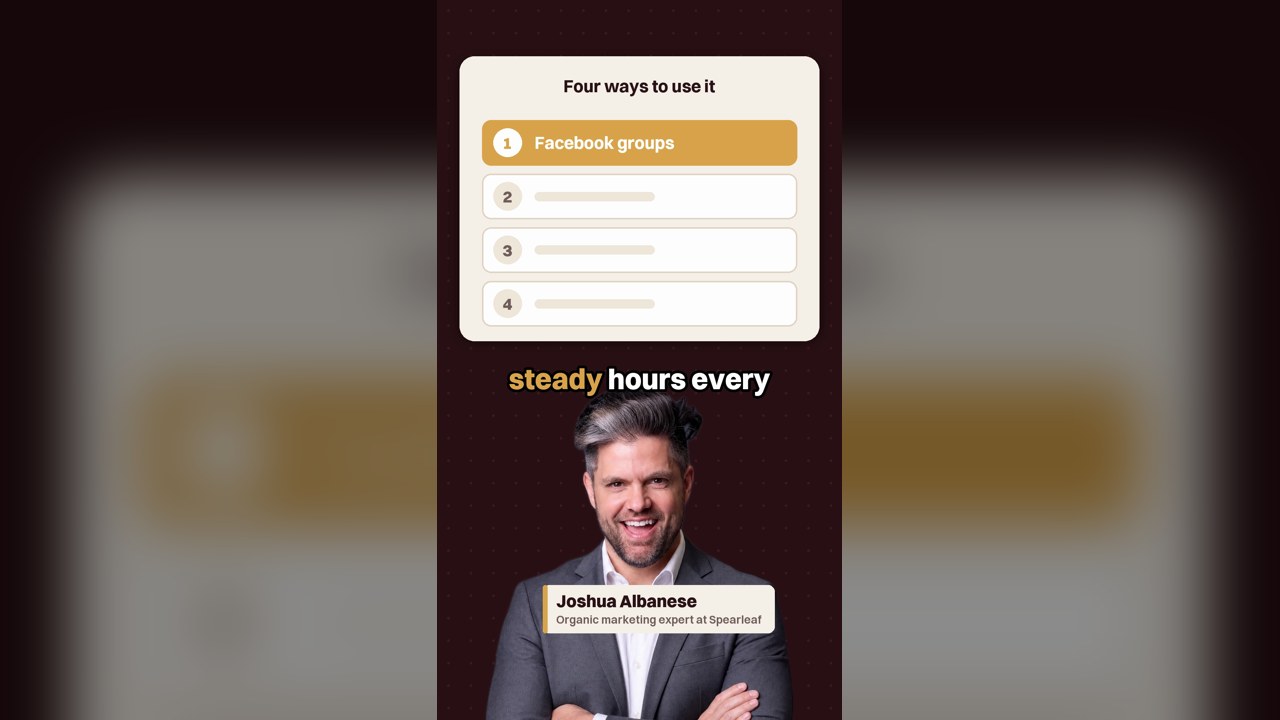
Social media for lawyers can sign clients when the platform fits how your clients pick a lawyer, and it mostly costs hours. This Spearleaf guide matches Facebook groups, LinkedIn, YouTube and Instagram to practice areas, then covers messages, bar rules and signed cases. Watch Joshua Albanese match four social platforms to law practices in a short video, with the hours each one costs.
Does social media for lawyers sign clients?
It can, when the platform matches how your clients choose a lawyer and someone answers the messages. The ABA's 2024 Websites and Marketing TechReport found 80% of respondents market on social media, led by LinkedIn (76%) and Facebook (53%). Read that as how common posting is, not proof it signs clients.
Many clients still start with someone they know. In Clio's 2019 Legal Trends Report (hosted by the DC Bar), 59% of 2,000 consumers sought a referral and 57% searched alone.
Say word of mouth works and you want more consistent lead flow. Social media can keep you in front of the people who refer you. If you need help getting found online, it also puts your answers where clients look.
Which social media platforms do your clients use?
YouTube and Facebook reach the most adults, and Instagram leans young. In Pew Research Center's 2025 survey, 84% of US adults used YouTube, 71% used Facebook and half used Instagram. Match the platform to the age of the clients you want.
Pew found YouTube and Facebook were the only sites a majority of every age group used. Instagram reached eight in ten adults aged 18 to 29, but only 19% of adults 65 and older.
So an estate planning practice serving retirees has more reason to be on Facebook and YouTube than on Instagram. I'd leave TikTok and X out of a first plan, since Pew found 37% of adults used TikTok and fewer used X.
Four social media platforms matched to law practices
Facebook groups for immigration and estate planning
Answer general questions in community, caregiver and retiree groups, like what a request for evidence means. Facebook groups cost steady hours every week, not ad money.
LinkedIn for referral sources
Other lawyers, CPAs and HR people see your name there, rather than people in trouble. LinkedIn costs a little time each week.
YouTube for the questions people search
One short video per question, such as a will or a living trust, or how mediation works in a custody case. YouTube takes the most hours of the four.
Instagram, kept small
Repost your YouTube answers as Reels instead of making separate posts. Instagram takes the least time and fits firms with younger clients.
Facebook groups for immigration and estate planning lawyers
Facebook groups work when you answer the general questions people already ask there. For immigration, that means what a request for evidence is, or why processing times are out of your hands. For estate planning, caregiver and retiree groups ask about powers of attorney and probate.
Keep every answer general. The New York State Bar Association's 2019 social media ethics guidelines allow general answers to legal questions on social media. They bar specific legal advice there, because a reply may be found to create an attorney-client relationship.
Those guidelines predate New York's 2026 advertising amendments, so check your own state bar's rules too. Read each group's rules before you post, and end a useful answer by saying the firm takes calls.
LinkedIn for lawyers who get work from referral sources
LinkedIn reaches the people who send you cases: other lawyers, CPAs and HR people. In Clio's 2019 survey, 16% of consumers sought a referral from a lawyer and 9% from another professional, like an accountant.
Post short notes on what you see in your practice, and comment on your referral sources' posts. Keep it to a little time each week, so it lasts.
LinkedIn is one piece of the wider law firm marketing mix, next to referrals, search and your website. It works best for firms whose cases come through other professionals.
How to turn intake questions into YouTube videos
- List the questions your intake team hears every week, like a will versus a living trust, or mediation in custody cases.
- Make one short video per question, and put the question in the title the way a client would type it.
- Answer in general terms, and say the firm takes calls about specific cases.
- Have a lawyer watch every video before it goes up, with the firm's name and contact details in the description.
- Embed each video on the matching page of your website, so one answer works in two places.
- Start with a handful of questions, because YouTube takes the most hours of the four platforms.
Instagram for law firms, kept small
Keep Instagram small: repost your YouTube answers there as Reels instead of making separate posts. It reaches younger clients best, since Pew found eight in ten adults aged 18 to 29 used Instagram.
Build a separate Instagram plan only if your clients skew young and the YouTube answers are already running.
Who answers social media messages at your law firm?
Decide that before you post more, so every inquiry gets a reply while the person is still choosing a lawyer. In Clio's 2019 survey of 2,000 consumers, 79% expected a response within 24 hours to a phone message or email. Choose one person to check messages every business day.
That survey asked about phone messages and email, not social media. Treat a direct message the same way, because it is the same moment for the person sending it.
Clio's report adds that people often contact more than one firm. A message that waits a week can mean a client who hired elsewhere, so set the owner and reply window first.
How to handle direct messages from potential clients
- Name who checks messages on each platform, plus a backup for days off.
- Set a reply window, and aim for one business day or less.
- Ask for names before the story, so the firm can run a conflict check first.
- Keep that first exchange short. ABA Model Rule 1.18 protects what a prospective client tells you, even if they never hire you.
- Move case questions to a phone call or consultation, and keep public replies general.
- Log each message's platform in your intake log, so you can count signed cases by source later.
Client details and case advice stay out of law firm social media
Two things never go in a post or reply: client details without informed consent, and advice on a stranger's own case.
-
ABA Model Rule 1.6(a) bars revealing information about a representation without the client's informed consent, unless impliedly authorized or an exception applies.
-
The duty covers public records, such as a court order, under ABA Formal Opinion 480 on blogging and public commentary.
-
Calling a client story a hypothetical does not help if readers could work out who the client is, the opinion says.
-
A lawyer working on a pending case can break Rule 3.6 on trial publicity with a post likely to materially prejudice it.
-
Replies to bad reviews follow the same rule. A Texas opinion cited in the NYSBA's 2019 guidelines allows a "proportional and restrained response that does not reveal any confidential information".
-
Your state's version of Rule 1.6 controls, and some states differ from the ABA model.
Bar advertising rules that apply to lawyer social media
ABA Model Rule 7.1 governs all communications about a lawyer's services, so posts that promote the firm count. Check your state bar's rules, because its version controls.
-
Keep every post true and not misleading, and never promise an outcome.
-
A past result can mislead without the facts behind it, says Comment 3 to Rule 7.1. A disclaimer may help.
-
Disclaimer rules differ by state. New York dropped its required past-results disclaimer on June 1, 2026. The NYSBA's summary of the amendments says lawyers may want to keep using it.
-
Never reward a review for its tone. The FTC's rule on consumer reviews bans fake reviews and incentives tied to positive or negative reviews.
-
Claim specialist certification only if an approved or ABA-accredited body certified you and the post names it, under Rule 7.2(c).
-
An ABA comment allows the plain word specialist based on experience, if it is not misleading. New York adopted the same approach in 2026.
-
Name at least one responsible lawyer or firm, with contact information, under Rule 7.2(d).
-
Practice in more than one state? Follow each state's advertising rules, as the NYSBA's 2019 guidelines advise.
Direct messages and solicitation rules for lawyers on social media
A public post answering a general question is not solicitation. ABA Model Rule 7.3 defines solicitation as a contact you start that offers to handle a specific matter. It covers people you know, or should know, need help with it. Its comments exclude public posts and replies to a request for information.
The ABA model bars live person-to-person solicitation when pay is a significant motive. Other lawyers, close or prior relationships and routine business clients are exceptions. Text messages and other easily ignored written messages are not live, it says.
New York adopted this ABA approach on June 1, 2026, per the NYSBA's summary of the amendments. Under Rule 7.3(c), never contact someone who said no, or use coercion, duress or harassment. States still differ, so check your state bar's rules before you message anyone about their case.
Staff and vendors who run law firm social media
Maybe a paralegal or a vendor runs the accounts and answers the messages. ABA Model Rule 5.3 requires partners and supervising lawyers to make reasonable efforts so outside help follows the lawyer's rules. A lawyer who orders or knowingly approves a rule-breaking post is responsible for it under Rule 5.3(c).
So nothing goes up and no reply goes out until a lawyer has read it. That includes posts drafted with AI tools.
Give your helper the rules in writing. Keep client details and case advice out, skip any certification you do not hold, and log every message by platform.
How to measure social media for lawyers by signed cases
- Add a required "how did you hear about us" field to your intake log, with each platform on a fixed list.
- Put tagged links in every profile and video description. Google Analytics Help explains how utm tags show which links sent each visit.
- Log the hours each person spends on each platform every week.
- Once a month, pull signed cases by source, and compare them with the hours each platform took.
- Count signed cases ahead of likes, followers and reach.
- Give one platform a few months before you judge it, then keep it, change it or drop it.
Plan the questions your law firm answers on YouTube and your website
Spearleaf's content strategy work maps the questions your clients ask before they hire, then plans the pages that answer them. The same list feeds your YouTube videos, and a lawyer at your firm approves anything that runs.
Talk to Spearleaf about content strategy
- Match channels to how clients hire: law firm marketing.
- The playbook: how to improve your Google rating.
- Start here: local SEO metrics that matter.