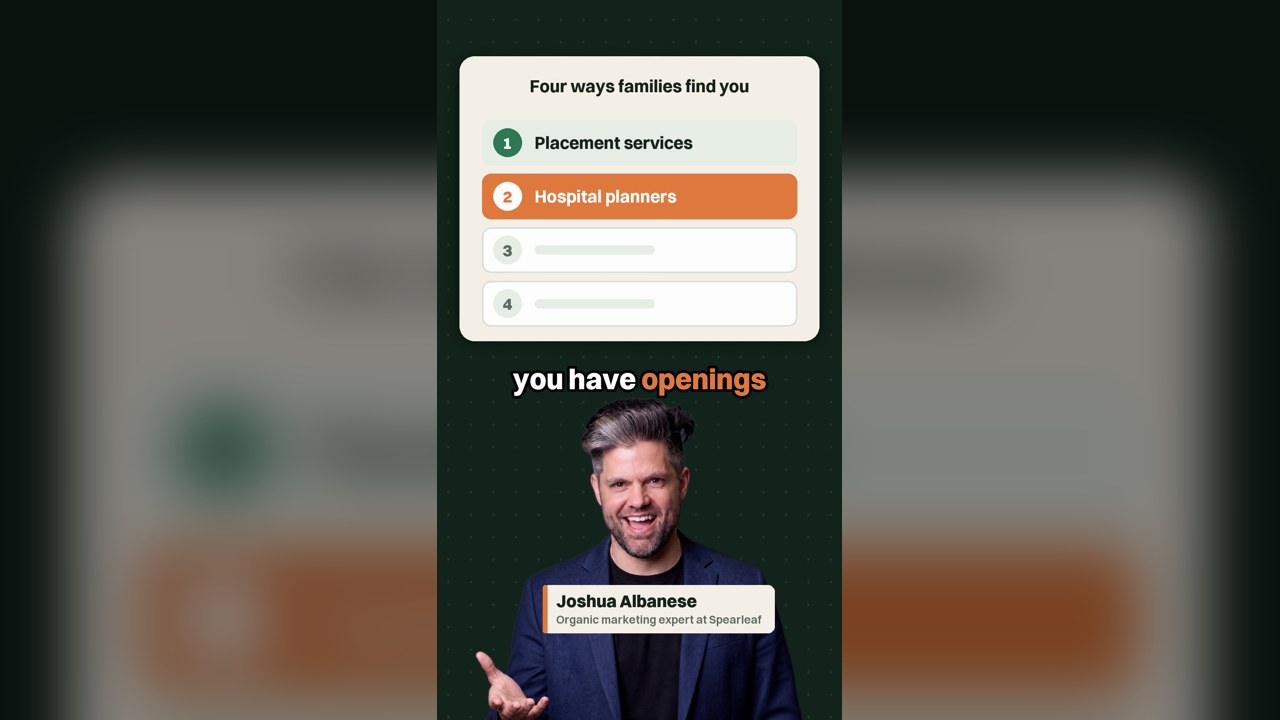
Assisted living marketing strategies work best when they reach the adult child comparing communities, who may be searching days after a parent's hospital stay. I'm Joshua Albanese, founder of Spearleaf, and my short video on assisted living marketing covers four ways families find a community. If word of mouth works but you want more consistent lead flow, here is each way, with its rules and its timeline.
What are the best assisted living marketing strategies for an independent community?
The best ones match how families arrive: placement services, hospital discharge planners, your website and family reviews on Google. Medicare.gov says Medicare doesn't pay for long-term care, so families pay privately, use long-term care insurance, or qualify for Medicaid. Write every page for the family member doing the research.
This guide sorts the four ways by speed and adds the step that turns an inquiry into a visit: answering fast and booking the tour. One small business owner on r/smallbusiness summed up long tactic lists: "Sorry, just feeling quite overwhelmed by all this info!"
Placement services and discharge planners can fill an apartment soon, while your website and reviews build over months. Plan to run both, and count tours and move-ins. One small business owner described where the slow side starts: "I searched my business on Google, and nothing showed up."
Four ways families find an assisted living community
Placement services
The fast clock. A placement service sends families and is paid by the communities it works with. Weigh that fee against an empty apartment.
Discharge planners and case managers
The fast clock. Hospital and rehab planners need a place for a patient soon. They call the community that answers quickly and says plainly what care it handles.
Your website
The slow clock. The adult child compares communities at night, on a phone. Real photos of real apartments and a plain explanation of pricing decide who gets the call.
Family reviews on Google
The slow clock. Families read what other families wrote before they call. Ask every family the same way, and offer nothing in return.
Senior placement services and the fee on every move-in
A placement service paid by communities is a paid lead channel, even when it is free to families. A Place for Mom's own site says it "is paid by our participating communities, therefore our service is offered at no charge to families."
Its terms of use add that the shortlists families see can reflect, in some instances, a community's partnership with the service. So the families you hear about depend partly on the agreement you sign.
That can still be a good trade. An apartment that stays empty for months also costs you money, so compare the fee with what a resident brings in over a typical stay. Then read the agreement closely, with your lawyer.
What to check in an assisted living placement agreement
Some states write rules for placement services, and Washington's RCW 18.330 covers referral agencies paid by assisted living facilities. Use its rules as a checklist, then check your own state.
-
Ask whether the agreement is exclusive. Washington bans exclusive agreements between an agency and a provider, and lets either side cancel.
-
Read the refund terms. In Washington, the agency refunds a prorated part of its fee if a resident dies or is hospitalized within thirty days of admission. A move to another setting for more appropriate care counts too.
-
Ask what families are told. Washington requires a dated disclosure to the family before a referral, including how a provider-paid fee is calculated.
-
Washington does not regulate the size of the fee, so the number is yours to negotiate.
-
Ask how the service handles a family who already called or toured your community before the referral.
-
Get your lawyer's eyes on the whole agreement before you sign.
Hospital discharge planners and case managers who refer to assisted living
Hospital discharge planners need a clear answer, so tell them what is open and what care you handle. Medicare's hospital rules require hospitals to assess a patient's need for "non-health care services and community based care providers". The same rule puts the patient's own goals and preferences at the center.
A planner needs a fast answer to two questions: can you take this resident, and when? Cookies dropped off every Friday don't answer either one. A short weekly note on open apartments, care levels and how fast you can assess someone does.
Rehab social workers, case managers and elder law attorneys talk to families at the same moment. Give each of them one direct number that someone answers.
Gifts to assisted living referral sources and anti-kickback rules
Many communities thank referral sources with lunches and gift baskets. Read the rules first, because they reach further than most owners expect.
-
The HHS Office of Inspector General says paying for referrals of federal health care program business is a crime. Medicaid counts.
-
Remuneration "includes anything of value," and the law covers the person who pays and the person who accepts.
-
State laws can reach private-pay residents too. Florida's patient brokering law makes it unlawful for "any person" to pay a kickback for a referral.
-
Florida's ban is not limited to Medicare or Medicaid business.
-
Ask your lawyer before you give a referral source anything of value, even a holiday basket.
-
Thank planners with fast answers, accurate openings and move-in dates you keep.
Your assisted living website, with real photos and how pricing works
Your website is where the adult child decides who to call tomorrow, often late at night on a phone. Show up when she searches your town, then show her what she came to see.
Use real photos of real apartments, the dining room and the outdoor space, not stock images. Include residents only with their written permission. Say which care levels you offer, in plain words, and name the towns families usually come from.
Many communities keep prices off the site. Explain how your pricing works anyway: the base rate, how care levels change it, what is included and who pays. Exact numbers are your call; the explanation is what earns the call. My team handles web design for service businesses.
What ChatGPT and Google's AI show when a family asks about assisted living
Some families ask ChatGPT or Google's AI instead of scrolling a list. In my August 2026 study, 48.2% of businesses ChatGPT showed were shown again days later (469/974). Check yours: ask "assisted living for my mom in" your town, and note who comes up.
Assisted living was not one of the 12 services I tested, so treat this as a pattern, not a measurement. Businesses with an address in the asked city had about 14 times the odds of being shown. That compares businesses within one search and is not proof of cause.
Keep your name, address, care levels and photos the same on your site, your Google listing and every directory. The rest is AI search optimization.
Answer every assisted living inquiry the same day and book the tour
- Call back every inquiry the same day, including evenings and weekends. A family that waits until tomorrow may tour somewhere else.
- Offer a specific tour time on that first call, not "someone will reach out."
- Let anyone at the front desk book tours on a shared calendar, even when the director is out.
- Ask the same intake questions every time: the town, the care needed, the move date and who pays.
- Say yes only to care levels you can staff, including memory care and nights.
- Ask every caller how they found you, and write the answer down.
Family reviews on your assisted living Google listing
Families read what other families wrote, so ask every family the same way, a few weeks after move-in. Thank them, and offer nothing for the review.
Google's content policy bans every incentive for a review, including payment, discounts and free services. It also bans selectively asking only happy customers, and removes reviews from employees. Don't ask your staff to review the community.
The FTC's 2024 rule, 16 CFR Part 465, bans fake reviews and rewards that depend on a review being positive or negative. It also bans review suppression, such as threats or intimidation to remove a negative review. For a steady system, see how to improve your Google rating without gaming it, or let my team run reputation management.
HIPAA and resident privacy in assisted living marketing
HIPAA does not cover every assisted living community, so start with the test, then follow the privacy habits either way.
-
HIPAA covers a health care provider that transmits health information electronically in a covered transaction, such as an electronic claim. Confirm your status with a lawyer.
-
Either way, get written permission before you use a resident's name, photo, story or quote.
-
Check every photo's background for care charts, medication carts and residents who did not agree.
-
Reply to reviews without confirming that the reviewer's parent lives with you, and without mentioning care details.
-
Keep move-in announcements and birthday posts to residents who said yes in writing.
-
Check your state's resident rights and privacy rules too, since some go further.
State licensing words in assisted living and memory care ads
States license assisted living differently, and some limit the words you can use in ads. In Florida, section 429.076 requires a memory care services license for any assisted living facility that advertises memory care services.
Florida's agency must adopt the rules by June 1, 2027, and existing facilities then get six months to obtain the license. The rules will list restricted ad terms, including memory care, dementia care and Alzheimer's care. Unlicensed facilities may describe optional supportive services without those terms, and must keep copies of those ads.
Other states use their own names and categories. Check your licensing agency before you write "memory care" anywhere, and use your exact licensed name on your website, listing and brochures.
Events, social media, email and paid ads for assisted living communities
Most assisted living marketing guides list events, social media, email and paid ads, and each helps in a supporting role. Host talks adult children want, such as paying for care or choosing a level of care, and open houses with a real meal.
Use social media to show daily life, with written permission for every resident photo. Email families who toured but did not move in yet, once a month, with real news from the community.
Paid search can bring inquiries sooner, but run it only once you can count which clicks became tours. My team runs Google Ads management as a complement to the organic work.
Run assisted living marketing strategies on two clocks
Run the fast clock and the slow clock at the same time. Placement services and discharge planners can fill an apartment this month, while the website and reviews build over the next few months.
Treat this as a planning lens, not a law. A community with a waitlist may not need the fast clock at all. A new building with no reviews will lean on it longer.
The lens also blurs in practice. A planner relationship can take months to earn, and a website fix can bring calls quickly from families who already know your name.
Track assisted living tours and move-ins by source
- One owner on r/smallbusiness put it plainly: "You'd need to ask every customer how they found you". Ask on every call and form.
- Log each inquiry in one spreadsheet: date, source, tour date and move-in date.
- Count a win only when a resident moves in, not when the phone rings.
- Each month, download your Business Profile performance report: calls and website clicks.
- Compare move-ins by source with what each source cost: placement fees, ad spend and staff time.
- Note how many months each resident stays, so you can weigh placement fees fairly.
Get help with local SEO for your assisted living community
My team at Spearleaf runs local SEO: your Google listing, reviews, website pages and the AI answers that read them. Once tours and planner relationships are running, it is the next lever for steady move-ins.
Talk to Spearleaf about local SEO
- Start here: how to get more calls from your Google Business Profile.
- Then this: how to improve your Google rating without gaming it.
- Then track it: local SEO metrics that matter.