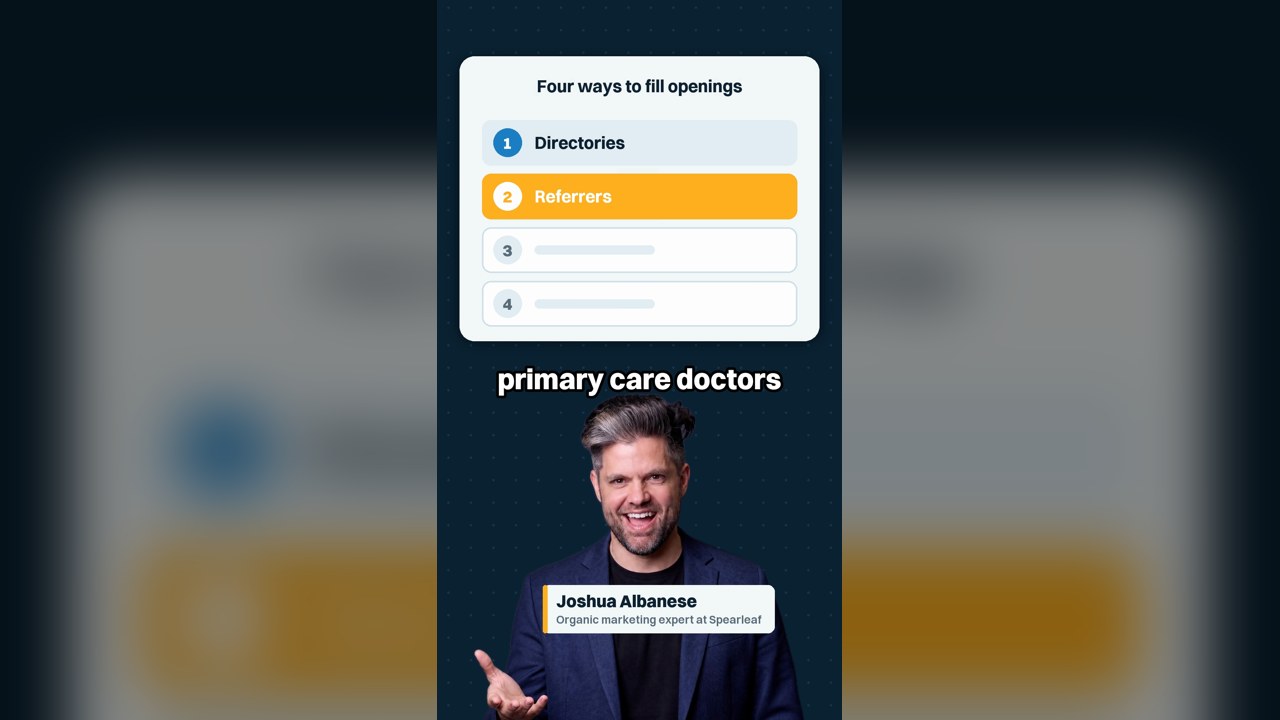
Marketing for therapists works best when you choose each channel by the kind of client it brings. Watch Joshua Albanese answer a therapist with three openings in a short video on four ways private practices fill them. I'm Joshua, founder of Spearleaf, and this guide adds the ethics, privacy and ad rules a therapy practice has to follow.
What marketing for therapists actually fills openings?
Four channels can fill a private practice's openings: directories like Psychology Today, referrers, paid search and specialty pages. In my August 2026 study, psychologytoday.com was the site ChatGPT cited most in all 18 therapist markets I tested. Choose the channels that bring the clients you want to see.
Word of mouth works, but you may want more consistent lead flow. Many therapists are good at what they do but need help getting found online.
Treat the four as a planning lens, not a law. Real clients mix them: someone referred by a doctor still reads your directory profile before calling.
Four ways therapists fill openings, sorted by the clients each brings
Directories like Psychology Today
People comparing several therapists at once, often by insurance and specialty. It is a monthly listing fee and the quickest of the four to set up. Your first lines decide who calls.
Referrers
Clients a psychiatrist, doctor or colleague already matched to you. It costs your time, not money. It works when referrers know your specialty and that you have openings.
Paid search
People searching right now, such as "therapist near me". You pay for each click at a price Google's auction sets. Judge it by consults booked, never by clicks.
Specialty pages
People searching one need, like a therapist for anxiety or EMDR. Pages on your own site build over months, with no cost per click when someone finds you.
Why so many new clients ask a therapist about insurance first
Many callers ask about insurance first because cost decides whether they can start. Under CMS rules, clients not using insurance generally get a good faith estimate on request or when booking 3+ business days ahead. Use your first lines to say how payment works, before anyone calls.
If you're private pay, say so near the top, and say whether you give superbills for out-of-network claims. Insurance shoppers then sort themselves out, and the calls left fit better.
Joining insurance panels is the other choice, and it changes who calls. Since January 1, 2024, marriage and family therapists and mental health counselors can bill Medicare independently, at 75% of the clinical psychologist rate.
Psychology Today and other therapist directories
A directory profile is often where people compare therapists side by side. The same study found ChatGPT cited psychologytoday.com more than any other site for therapists, so ChatGPT reads those profiles too.
The listing is a monthly fee. NBCC's partner page lists it at $29.95 a month after a six-month free trial for National Certified Counselors. It also says the listing includes call tracking.
A directory is rented space, so keep your own website as the home base. My team handles web design for practices that need one.
How to write a directory profile that brings the right clients
- Open with who you help and what changes for them, in the words a client would use.
- Name your specialties and methods, such as EMDR or couples work, only where your training supports them.
- Say in the first lines whether you're in network, private pay or both, and whether you give superbills.
- State that you have openings now, and update the profile the day they fill.
- List the towns you see clients in, and the states where you're licensed for telehealth.
- End with one next step: call, email, or book a consult call online.
Referrals from psychiatrists, doctors and other therapists
Referrers send clients who already trust the match. APA Services suggests relationships with primary care physicians, OB/GYNs, school counselors, lawyers, religious leaders and other mental health professionals. Tell each one your specialty in one sentence.
Then tell them again when you have openings. A short note the week a slot opens is easy for a busy referrer to act on.
Never pay or reward anyone for a referral. APA Standard 6.07 says payments between professionals rest on services, not the referral itself. ACA's code (A.10.b) bars commissions or rebates for referring clients.
Google Ads for therapists and the rules Google adds
Paid search reaches people searching right now, and you pay for every click. Google's policy on health in personalized advertising puts counseling for depression, anxiety and addiction in a sensitive health category.
That rules out ads aimed at your own client list or past website visitors. For these ads, the policy bars uploaded customer lists, your data segments and lookalike segments. Location targeting is allowed.
A reviewer of a marketing agency described the usual trap: "I was getting ALOT of clicks and no calls". My team runs Google Ads management when ads fit the practice.
How to judge Google Ads by consults, not clicks
- Check local click prices for your specialty searches in Keyword Planner before you set a budget.
- Turn on call tracking with a Google forwarding number, and set a minimum call length so hang-ups don't count.
- Ask every caller how they found you, and write the answer down.
- Count consults booked from ads each week, and how many became ongoing clients.
- Pause any search term that brings clicks and no consults after a month of tracking.
Keep therapy clients' data out of your ad tracking
Ad tags on intake and booking forms can send sensitive details to ad platforms. In 2023, BetterHelp agreed to pay $7.8 million to settle FTC charges. The FTC said it shared email addresses and health questionnaire answers with Facebook and Snapchat for ads.
Keep ad and analytics tags off intake forms and booking pages. Ask whoever built your site what each tag sends.
If you're a HIPAA covered entity, the Privacy Rule bars disclosing protected health information except as it permits. Ask your compliance adviser before adding any tracking.
Specialty pages for searches like therapist for anxiety
A specialty page answers one need on your own site, such as anxiety, trauma, couples work or EMDR. Google's local ranking help page names relevance, distance and prominence, and says you can't pay for a better local ranking. Build one page per specialty you want more of.
These pages build over months, with no cost per click when someone finds you. Say what the work looks like, who it fits, how payment works and how to book.
Keep every claim accurate. ACA's code (C.3.a) requires counselors to present credentials in a way that is not false, misleading, deceptive or fraudulent. My team builds these pages as part of local SEO.
What ChatGPT and Google's AI show when someone asks for a therapist
ChatGPT's answers for therapists lean heavily on Psychology Today, and Google's AI Overview rarely appears. In my August 2026 study, the AI Overview fired on 13.9% of therapist questions, and only 2 of 79 traceable therapist ratings were Yelp's. Check yours by asking ChatGPT for a therapist for your specialty in your town.
Across all 12 services, businesses that stayed in ChatGPT's answers had more reviews (median 226 vs 164) at the same 4.9 rating. For therapists, review asks run into ethics rules, covered below.
So I'd put the effort into your directory profile and your own specialty pages. That is the ground AI search optimization builds on.
Your Google Business Profile as a therapist or group practice
Google treats a public-facing professional with their own clients as an individual practitioner. Google's guidelines give one their own Business Profile if they can be reached at the verified location during stated hours. Check that before listing a telehealth-only practice.
Keep one profile per therapist, never one per specialty. At a group location, the practice gets its own profile, and each therapist's profile carries only their name.
A solo therapist at a branded practice shares one profile, named with the brand, a colon, then the therapist's name. The performance page shows calls and website clicks, per Google's help page. My team handles Google Business Profile optimization.
Can therapists ask clients for reviews and testimonials?
Not current clients under the APA, ACA or NASW codes, and ACA's code reaches further. APA Standard 5.05 bars soliciting testimonials from current therapy clients or anyone vulnerable to undue influence. Check your own code and your state board before you ask anyone.
ACA's code (C.3.b) also covers former clients, and requires permission for any testimonial you use. NASW's Standard 4.07 covers current clients and vulnerable people, including asking consent to reuse something a client said.
Google's review policy bans incentives and asking only happy clients. The FTC's 2024 rule bans rewards tied to a positive or negative review.
How to reply to reviews without breaking confidentiality
Reply in general terms that reveal nothing, or don't reply at all. HIPAA's Privacy Rule limits disclosures, and NASW's Standard 1.07 and ACA's B.1.c require confidentiality. Use these rules, or hand them to your reputation management partner:
-
Never confirm or deny that the reviewer is or was your client.
-
Leave out names, dates, diagnoses, session details and payment details.
-
Use one general reply about how your practice works, whatever the review says.
-
Consider a standing note that you don't reply to reviews, to protect privacy.
-
Invite anyone with a concern to contact the office directly.
-
Ask your liability insurer or attorney about any review that feels risky.
Content, social media and email for a therapy practice
Content works when it teaches in general terms and points to your services. APA Services suggests free talks for community groups and writing for local outlets. Blog posts, short videos and an email newsletter can do the same job online.
Keep posts general, and never give therapy in a comment thread. ACA's code (H.6.a) says counselors who keep a personal social media presence should separate it from the professional one.
Add a crisis line to your site and profiles. SAMHSA says 988 offers 24/7 support by call, text or chat.
Call back the same day, or let clients book the consult online
The cheapest client to win is the one already calling you. Someone finally ready to reach out may keep calling down the list, so I recommend a same-day callback.
If you're in session all day, block a set time each afternoon for callbacks. Or add online booking for the consult call, so people can pick a time themselves.
Say on your voicemail when you'll call back, and keep that promise.
The therapist marketing mix, by timeline
Lean on the fast channels now, and build the slow ones alongside them.
-
This week: same-day callbacks and a rewritten directory profile.
-
This month: a note to each referrer with your specialty and your openings.
-
Over months: specialty pages on your site and a complete Google Business Profile.
-
Once you can track it: a small paid search test, judged by consults booked.
-
All year: general content and community talks, within your code.
How to track which channel brings ongoing clients
Track two numbers by source: consults booked, and consults that became ongoing clients. Google's help page shows profile calls and website clicks, and NBCC says the Psychology Today listing includes call tracking. Ask "How did you hear about me?" on every intake form and first call.
One owner on r/smallbusiness put it plainly: "You'd need to ask every customer how they found you". Keep a simple sheet with the date, source, consult booked and whether they stayed.
Pick your own line for "ongoing", such as a third session. For what else to count, see local SEO metrics that matter.
Get local SEO help for your private practice
My team at Spearleaf runs local SEO for service businesses: the Google Business Profile, specialty pages and the AI answers that read them. Once your callbacks and referrers are running, it is the next lever for steady clients.
Talk to Spearleaf about local SEO
- Compare them: local SEO vs Google Ads.
- Then read: ChatGPT vs Google for a local business.
- Start here: how to get more calls from your Google Business Profile.