
Seven quick, do-it-yourself local SEO tips a busy owner can knock out in a single week.
I'm Joshua Albanese, founder of Spearleaf, and the question I hear most from local owners is some version of "I don't have a marketing budget or a spare month, so what can I actually do myself?" Plenty, it turns out. These seven local SEO tips are the ones I'd hand a busy owner to work through in a single week, in the order I'd do them, and they're the foundation our local SEO program is built on.

What are the best local SEO tips you can do this week?
The best quick local SEO tip is to claim and fully complete your Google Business Profile, because it's free, fast, and it feeds all three of Google's local ranking factors at once. Everything else on this list builds on that foundation.
I've kept these seven deliberately small. Each one is something you can finish in an hour or two, without hiring anyone or writing a line of code. None of them require a budget. Do them in order and you'll have moved the needle by Friday.
If you want the full, exhaustive version later, our on-page SEO checklist goes deeper on the website side, and if you're weighing what all of this is worth in dollars, our breakdown of SEO cost for a small business lays out the strategy and the budget honestly. This post is the fast, hands-on start.
1. Claim and complete your Google Business Profile
Your Google Business Profile is the asset Google scores your local rankings through, so a complete one is the highest-return hour you'll spend this week.
Go to google.com/business, claim your listing, and verify it if you haven't. Then fill in every field. Set the most accurate primary category, list your services, add complete hours, write a real description, and upload genuine photos of your work and your team. Empty fields are missed ranking signals.
If you serve customers at their location rather than yours, set up a service area instead of a public address. Get this one right and you've done the single most important thing on this list.
2. Ask three happy customers for a review
Reviews are a prominence signal Google names directly, and they're the first thing a nervous customer checks before calling you.
This week, pick three customers you know were happy and ask each one for a Google review. Send them your direct review link so it takes ten seconds, not ten minutes. The best moment is right after you've finished a job well, while the good feeling is fresh.
Never buy reviews, never offer a discount for one, and never filter out the unhappy ones. That's called review-gating, it's against Google's rules, and it risks your whole profile. The system that keeps this going long term lives in our guide on getting more Google reviews. For this week, three honest asks is the whole task.
3. Make your name, address, and phone match everywhere
Local SEO tips almost always include this one because it's boring and it works: your business name, address, and phone number need to read exactly the same everywhere they appear online.
Google reads consistent contact information as a trust signal. When your listings conflict, one address on Yelp, an old phone number on Facebook, a slightly different name on your site, that noise works against you. Pick one exact format and treat it as the truth.
Spend an hour this week auditing the obvious ones: your website footer, Google Business Profile, Yelp, Facebook, and any industry directories you're on. Fix anything that doesn't match. That consistency is what the pros call NAP, and it quietly props up everything else.
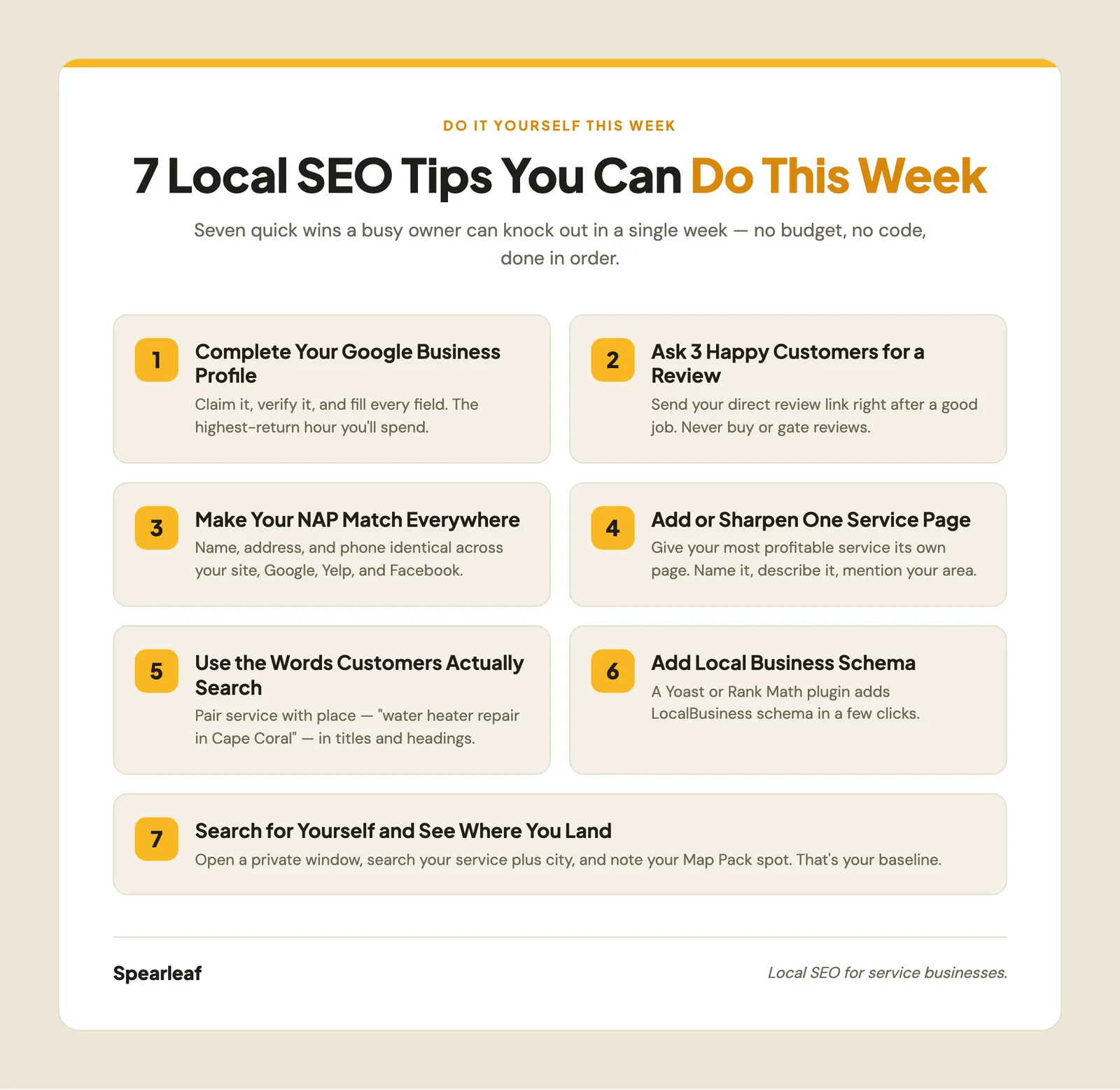
4. Add or sharpen one service page
Your website feeds the relevance factor, and the fastest way to strengthen it is a dedicated page for each core service you offer.
If you've got a one-page site that lists everything in a paragraph, Google has almost nothing specific to match a search against. This week, pick your most profitable service and give it its own page. Name the service in the heading, describe exactly what it includes, and mention the areas you serve.
You don't need to build ten pages by Friday. One solid, specific service page is a real signal you didn't have before. Add the next one next week.
5. Use the words your customers actually search
The phrases real customers type, like "emergency plumber in Fort Myers" or "roof repair near me," need to appear naturally in your page titles, headings, and copy.
This isn't about stuffing keywords. It's about matching the plain language people use. Think about the exact wording a customer would say out loud, then make sure that phrasing shows up where it fits: your page title, your main heading, and once or twice in the body.
Pair the service with the place. "Water heater repair" is fine, but "water heater repair in Cape Coral" tells Google both what you do and where you do it. That combination is what "near me" searches reward.
6. Add local business schema to your site
Schema is a small piece of code that spells out your business details for search engines and AI answer engines in a format they read perfectly.
If your site runs on WordPress, a plugin like Yoast or Rank Math can add LocalBusiness schema for you in a few clicks, no coding needed. It confirms your name, address, phone, hours, and service area directly to Google, and it increasingly helps AI tools like ChatGPT and Google's AI Overviews recommend you correctly.
This one takes fifteen minutes with the right plugin and removes any ambiguity about who and where you are. If you're on a different platform, search that platform's name plus "local business schema" for its specific method.
7. Search for yourself and see where you land
The last tip this week is simple: open a private browser window and search the way a customer would, then honestly note where you show up.
Type your main service plus your city, like "hvac repair Fort Myers," and look at the Map Pack, the block of three businesses with a map. Are you in it? On page one? Nowhere? Do the same for two or three of your top services. Write down what you find.
That five-minute check is your baseline. It tells you which services already rank and which need the work above. If you're not showing up at all where you expect to, our post on why your business might not be showing up on Google walks through the specific reasons, and the Google Map Pack ranking factors explain what moves those three spots.
What to expect after your first week
Doing these seven this week won't put you at the top of the Map Pack by next Monday, and any local SEO tips that promise that are lying to you.
What you will have is a complete profile, a few fresh reviews, consistent listings, a stronger service page, cleaner keywords, working schema, and an honest baseline. That's the foundation, and it's more than most of your competitors have bothered to do. Local SEO compounds, so the early work you just finished is exactly the part that pays off later. For a realistic view of the timeline ahead, our guide on how long SEO takes sets fair expectations by phase.
Keep the habits going. Ask for a review every week, add another service page when you can, and re-check your rankings once a month. There's no trick that beats doing the basics well, longer than the shop down the street does. That's the most encouraging thing I can tell any owner who felt like search was rigged. It isn't. It rewards the people who just keep showing up.
The questions I hear most from owners trying to do their own local SEO, answered plainly.
Ready to stop doing this alone?
These seven tips are the exact fundamentals I'd start any local business on: a complete Google Business Profile, a steady review habit, consistent listings, real service pages, plain-language keywords, working schema, and a monthly ranking check. Do them and you're already ahead of most of your local competition. If you'd rather have a team build and maintain all of it in the right order, our local SEO program is designed to grow durable lead flow for service businesses, with no long contract, just the fundamentals executed consistently.
This article was written by Joshua Albanese, founder of Spearleaf, a local SEO and marketing agency based in Fort Myers, Florida. Joshua has built six businesses from zero using organic search and content, and he leads Spearleaf's SEO, AI search, and local strategy for service businesses across the U.S.
Frequently asked questions
What is the fastest local SEO tip I can do myself?
Claim and complete your Google Business Profile. It is the single highest-impact thing an owner can do in an afternoon, and it is free. Pick the most accurate primary category, fill in every field, add real photos, and confirm your hours. Google scores all three of its local ranking factors through that profile, so a complete one starts working faster than almost anything else you can touch.
Can I really improve my local SEO in one week?
Yes, for the fundamentals. You will not outrank an established competitor in seven days, but you can fix the things holding you back: an incomplete profile, missing service pages, inconsistent contact info, and no review habit. Local SEO compounds, so the point of week one is to set the pieces in motion, not to finish. The early work carries the most weight later.
How many reviews do I need to rank in the Map Pack?
There is no magic number, and anyone quoting one is guessing. Review count and rating are prominence signals Google names directly, and recency matters too, so a steady trickle of honest reviews beats a one-time burst. Focus on building a habit of asking every happy customer right after a good job, rather than chasing a target. Never buy or gate reviews; it puts your whole profile at risk.
Do I need a website to do local SEO?
You can rank in the Map Pack with a thin site, but a real website makes every other signal stronger. A page for each core service tells Google what you do, and content that names your service area tells it where. If you only have a one-page site, adding dedicated service pages is one of the highest-value moves on this list. It feeds the relevance factor directly.
Is doing local SEO myself enough, or do I need help?
The fundamentals on this list are genuinely doable yourself, and plenty of owners handle them well. Where most people hit a wall is time and the compounding work: building out pages, cleaning listings across dozens of sites, and out-signaling competitors month after month. Start it yourself, get the basics solid, and bring in help when the ongoing grind starts costing you more than it saves.
Want the whole thing built and maintained for you? See how our local SEO program grows steady lead flow.
Learn more →