
Local SEO for small business is the practice of winning nearby searches you can actually compete for, instead of fighting the whole internet for attention you will never afford. It works because local search rewards the closest, most relevant, best-reviewed result, not the biggest brand, which is exactly what our local SEO program is built to help you become in your own market.
I'm Joshua Albanese, founder of Spearleaf, and I built six businesses from zero using organic search before I ever ran an agency. The question I hear most from owners is some version of "how am I supposed to beat the big guys?" So here is the honest answer: you compete on the things size cannot buy.

If you want the flat, do-this-in-order to-do list, our GBP optimization checklist covers the mechanical steps. This post is the other half: the strategy for actually competing and winning nearby when you are the smaller name. Nine ways, in the order I would tackle them.
Why small businesses can win local search
A small business can out-rank a bigger competitor because local search scores relevance, distance, and trust, not company size. Those are levers a focused local owner can pull faster than a chain can.
Google publicly names its three local ranking factors as relevance, distance, and prominence, and none of them is "how big is your company." A national brand has to earn those signals in hundreds of cities at once. You only have to earn them in the handful of miles where your customers live. That is a narrower fight, and a narrow fight favors the specialist. My whole career has been proof that the small, sharp operator beats the big, distracted one on their own street.
1. Own your Google Business Profile like it is your storefront
Your Google Business Profile is the single asset that decides most of your local visibility, so treat it like your front window, not a form you filled out once.
A claimed, verified, and fully completed profile is where a small business stands on equal footing with anyone. Set the right primary category, list every service, load real photos, keep your hours accurate, and post updates the way a bigger competitor never bothers to. Most owners set theirs up and abandon it, which is the exact gap you exploit by staying active.
2. Turn happy customers into a steady review habit
Reviews are a trust signal Google names directly, and they are the first thing a nervous customer checks before calling. A small business that asks well can out-review a distracted competitor.
The work is a habit, not a campaign. Ask right after a good job, make it a one-tap link, and reply to every review you get. Never buy or gate them, which puts your whole profile at risk and is a line we will not cross. The system that makes this repeatable lives in our guide on getting more Google reviews.
3. Win the streets around you, not the whole city
Proximity is a ranking factor you cannot fake, so aim for the searches where you are genuinely the closest strong option and build out from there.
A national chain has to rank everywhere. You do not. Pick the neighborhoods and towns you actually serve well, make sure your address or service-area setup is exact, and describe those areas honestly on your site. Winning three ZIP codes decisively beats placing tenth across a whole metro. Concentration is the small business advantage.
4. Build a real page for every service you offer
Your website feeds the relevance signal, and a dedicated page per service tells Google exactly what you do far better than one crowded homepage.
Thin, one-page sites give Google almost nothing to match against a specific search. A separate page for each core service, written for the person searching for that service, closes the gap fast. This is where a small owner who cares out-writes a chain running templated copy. The fundamentals here live in our on-page SEO checklist.
5. Go narrow where the big brand goes broad
Specificity is a small business's sharpest weapon, so claim the specialized searches a general competitor is too broad to rank for.
A big brand optimizes for the head term, "plumber," and leaves the long tail wide open. That is your lane. "Tankless water heater repair" or "senior move-out cleaning" carries less volume but far more intent and far less competition. Rank for a dozen of those specific searches and you assemble a customer base the generalist never sees coming. Depth beats breadth when you are small.
6. Answer faster than anyone else in your market
Response speed is a differentiator search cannot measure directly but customers reward immediately, and it is where an owner-run shop crushes a big call center.
When someone finds you in the Map Pack and calls, the business that answers gets the job, not the one ranked slightly higher that sends them to voicemail. Same for the message that comes through your profile. A local owner who picks up the phone converts the visibility the other tactics earn. All the ranking in the world means nothing if the lead goes cold on hold.
7. Earn links from your own community
Local backlinks are a prominence signal, and the relationships a small business already has in town are links a distant chain simply cannot get.
Google reads links from local news, community groups, chambers, and industry associations as proof you are a real, established part of your area. Sponsor the little-league team, join the local business group, get quoted in the neighborhood paper. Those are natural, ethical links that quietly out-rank a competitor's generic directory listings. Local relevance beats raw volume every time.
8. Show up in AI answers, not just the Map Pack
AI search runs on the same signals as local SEO, so the work that ranks you on Google also gets you recommended by ChatGPT and Google's AI Overviews.
When someone asks an AI assistant for a local recommendation, it leans on verified profiles, consistent information, genuine reviews, and clear content, the exact things the first seven tactics build. Do the fundamentals and you compete on both surfaces at once, which is why we treat AI search optimization as part of the same effort rather than a separate project.
9. Keep your information identical everywhere
Consistency is the quiet tactic that decides ties, so pick one exact business name, address, and phone format and use it on every site that lists you.
When your details match across Google, Yelp, Facebook, and the rest, Google trusts your information and ranks it with confidence. When they conflict, that noise drags you down while a tidier competitor climbs past you. A small business can audit and fix this in an afternoon; a sprawling brand with a thousand stale listings often cannot. Small and consistent beats big and messy.
What competing nearby actually takes
Winning locally as a small business is less about budget and more about doing a focused set of things well, longer than the competition bothers to.
None of these nine tactics requires a big spend or a trick. They reward you for being genuinely good, genuinely findable, and genuinely present in your area. If your visibility has stalled and you are not sure which lever is stuck, our post on why your business might not be showing up on Google diagnoses the usual culprits. I will say plainly what I tell every owner: local search is not rigged against the small guy. It is a game of doing the basics well, on your own streets, for longer than a distracted competitor will.
The questions I hear most from owners trying to compete for local customers, answered plainly.
Ready to out-compete the bigger name nearby?
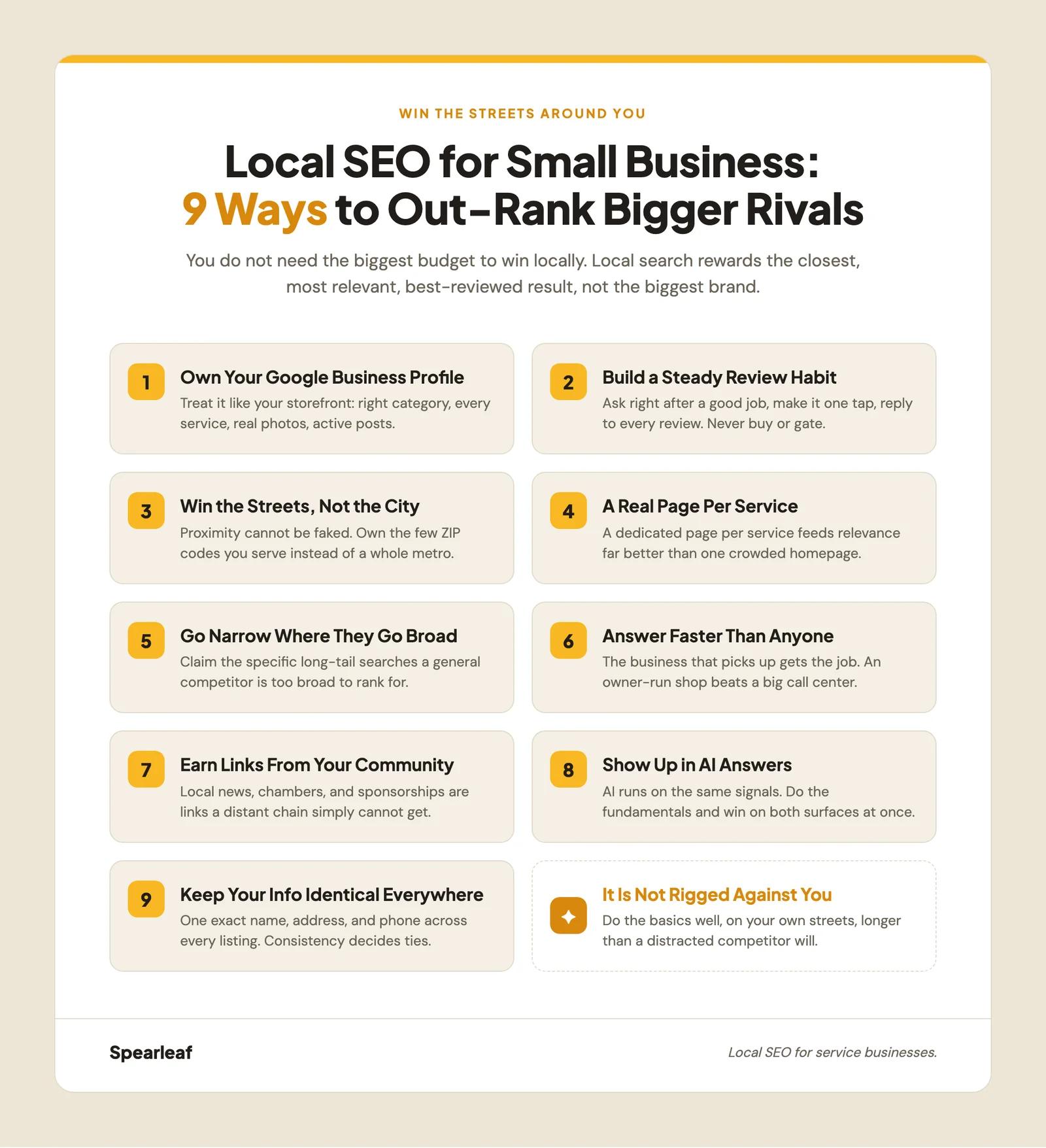
Competing locally comes down to a focused set of moves: own your Google Business Profile, build a real review habit, win the streets around you, publish a page per service, go narrow, answer fast, earn community links, show up in AI answers, and keep your information identical everywhere. Do them well and a small business out-ranks bigger competitors on the searches that matter most. If you would rather a team run all nine in the right order, our local SEO program is built to grow durable lead flow for service businesses, with no long contract, just the fundamentals executed consistently.
This article was written by Joshua Albanese, founder of Spearleaf, a local SEO and marketing agency based in Fort Myers, Florida. Joshua has built six businesses from zero using organic search and content, and he leads Spearleaf's SEO, AI search, and local strategy for service businesses across the U.S.