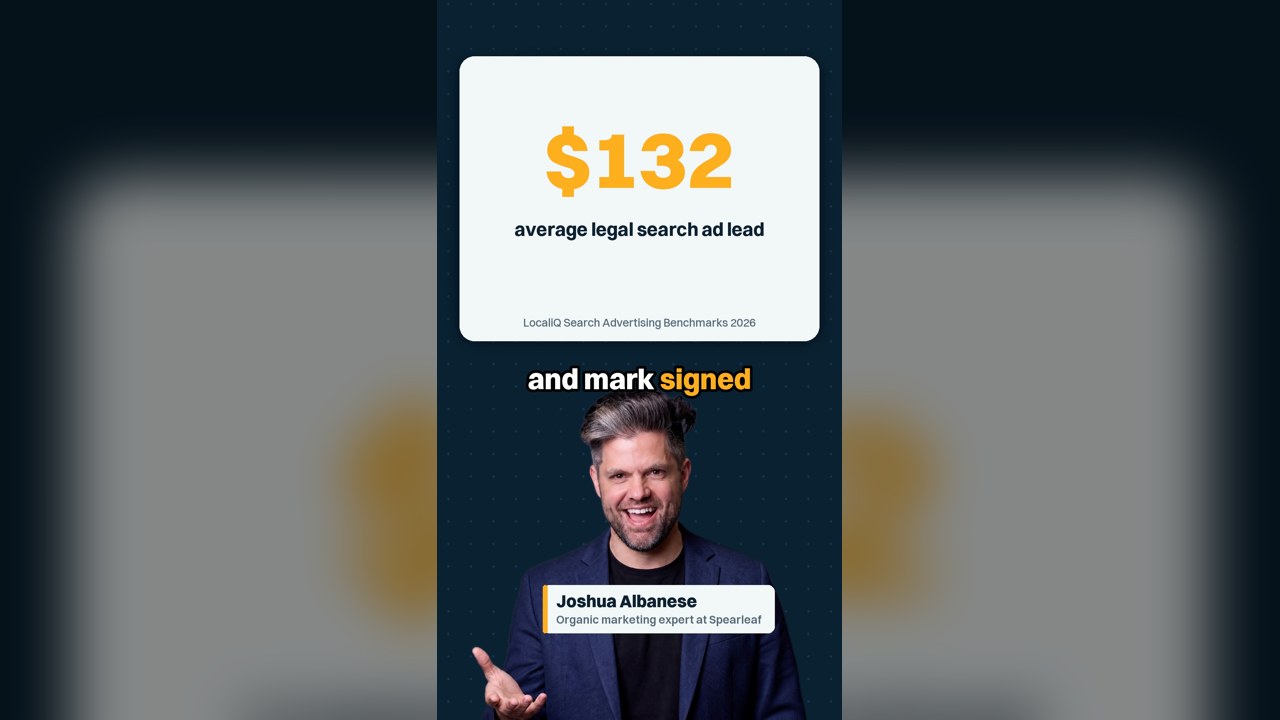
Law firm advertising pays off when you choose each channel for the cases it brings in, then count signed cases instead of calls. The main paid options are Google search ads, Local Services Ads, Facebook and Instagram, and directories or lead sellers. Watch Joshua Albanese explain four ways law firms advertise and which one signs cases in a short video.
How do law firms advertise?
Law firms advertise mainly through Google search ads, Local Services Ads, Facebook and Instagram, and paid directories or lead sellers. ABA Model Rule 7.2 lets a lawyer share information about their services through any media, within the rules. Choose channels by the cases you want, then count which ones sign.
Truthful lawyer advertising has had constitutional protection for decades. In Bates v. State Bar of Arizona (1977), the Supreme Court ruled that truthful ads for routine legal services may not be restrained.
Many firms start advertising because word of mouth works, but they want more consistent lead flow. Ads can add that flow. They can also add bills that never turn into clients, so plan the measurement before the first dollar.
Google search ads reach people looking for a lawyer right now
Google search ads show your firm when someone types a search like "DUI lawyer near me," and they start fast. Google Ads Help says most ads are reviewed within one business day. A new campaign can often run within a day or two.
You pay for each click, and click costs vary widely by practice area and city. A click or a call is a lead, and a lead isn't a signed client. Judge search ads by signed cases, which I cover below.
Two common problems show up in owner reviews of ad agencies. One owner wrote, "I was getting ALOT of clicks and no calls". Another wrote that once calls started, "it was for things that we did not service, or was not anywhere near our location."
How to set up Google Ads so the firm sees the real numbers
- Open the Google Ads account in the firm's name, with a partner as an admin. Under Google Ads access levels, only admins can give account access and change access levels.
- Set location targeting to Presence. By default, Google's location options also reach people who have shown interest in your area, not just people there.
- Run ads only during hours when someone at the firm answers the phone, because you pay for the click either way.
- Turn on call reporting, which puts a Google forwarding number on your ads and records call length and whether the call connected.
- Keep criminal defense ads about legal representation. Google Ads does not allow bail bond ads, including immigration and detention bail services.
- Have a lawyer at the firm approve every ad and landing page, and name the responsible lawyer or firm with contact information.
Local Services Ads for lawyers check licenses, not skill
Local Services Ads carry a Google Verified badge, and you pay per valid lead, such as an answered call, message or voicemail. For lawyers, Google runs state bar license checks for each lawyer in the firm, and screening averages 3 to 4 weeks.
That badge means the firm passed the checks, not that Google graded anyone's skill. Google's ad ranking page says rating, number of reviews and response time feed profile quality. Stronger profiles may rank higher and pay less per lead.
Answer during your ad hours. Google can charge for a missed call during business hours when the caller stays on the line more than 20 seconds. Google issues credits for leads it finds poor quality, duplicate or invalid, so review your leads inbox weekly.
Facebook and Instagram ads suit planned legal matters
Facebook and Instagram reach people before they search. That suits a will or a family visa petition better than the call from jail, where the person is already searching. Sort your practice first with law firm marketing for crisis and planned clients.
Meta's ad system asks whether each campaign falls in a Special Ad Category: housing, employment, financial products and services, or social issues, elections or politics. Legal services is not on that list, though an ad taking a position on immigration policy may count as a social issue.
Ads about divorce, injury or immigration draw public comments. Hide or moderate comments on those posts, and never discuss a client's matter in a reply.
Directories, lead sellers and referral services under ABA Rule 7.2
Paying for leads is allowed, within limits that sit in the comments to ABA Model Rule 7.2. Your state bar's version controls.
-
You may pay for advertising, including print and online directory listings, TV and radio airtime and Internet ads, under Comment [3].
-
A directory that lists lawyers by practice area, without more, is not a paid "recommendation" under Comment [2].
-
You may pay a lead generator only if it does not recommend you. The payment must also fit Rule 1.5(e) on fee division and Rule 5.4 on professional independence.
-
Under Comment [5], never pay a lead generator that states or implies it recommends you. The same goes for one that claims to refer for free or to have analyzed the person's legal problem.
-
Rule 7.2(b)(2) lets you pay the usual charges of a legal service plan or a not-for-profit lawyer referral service. A for-profit service must be qualified, meaning a regulator approved it.
-
When a lead seller swears its cases are exclusive, ask to see its ads and intake script. Comment [5] points to your duties for what the nonlawyers you pay do.
TV, billboards and radio for larger law firms
Bigger firms add TV, billboards and radio to make their name familiar. Expect much of the response to arrive later as searches for your firm's name, not as calls tied to one ad. Report these channels apart so they do not borrow credit from search ads.
Google Search Console's Performance report shows the queries people used to find your site. Compare searches for your firm's name before, during and after a campaign.
Some states review broadcast ads before they air. The Florida Bar requires TV, radio, print and billboard ads to be filed 20 days before first use. Ads limited to "safe harbor" information are exempt.
ABA Rule 7.1 keeps attorney advertising true and not misleading
Each state adopts its own version of the ABA Model Rules of Professional Conduct, so your state bar's text controls. Here is what the model rules say about ads.
-
Rule 7.1: a lawyer "shall not make a false or misleading communication" about the lawyer or the lawyer's services. Leaving out a fact needed to keep the whole message from misleading counts too.
-
Past results: under Comment [3] to Rule 7.1, true results can still mislead if they suggest other clients will get the same outcome. A disclaimer or qualifying language may prevent that.
-
Comparisons: the same comment warns that unsubstantiated claims about your services or fees, or comparisons with other firms, may mislead when stated as if provable.
-
Truth applies everywhere: website pages, social posts, directory profiles and anything a lead seller says on your behalf.
ABA Rules 7.2 and 7.3 on payments, specialists and solicitation
The next two rules cover who you can pay, what you can call yourself, and who you can contact. Read them in ABA Model Rule 7.3 and Rule 7.2.
-
Rule 7.2(b): never pay anyone for recommending you. The exceptions are ad costs, legal service plans and qualified referral services, buying a practice, disclosed non-exclusive reciprocal referrals, and nominal thank-you gifts.
-
Rule 7.2(c): say you are a certified specialist only if an approved or ABA-accredited body certified you, and name that body in the ad.
-
Rule 7.2(d): every ad must include the name and contact information of at least one lawyer or law firm responsible for its content.
-
Rule 7.3(b): no live person-to-person solicitation when a significant motive is the fee. The exceptions are other lawyers, family, close personal or prior business or professional relationships, and routine business users of that service.
-
Rule 7.3(c) to (e): never solicit someone who said no, or through coercion, duress or harassment. Communications authorized by law or ordered by a court, and certain prepaid legal plans, are carved out.
-
Ads aimed at the general public, such as a billboard, a website or an Internet banner ad, are not solicitation under Comment [1] to Rule 7.3.
State bar rules that add labels, filing and waiting periods
States add their own layers and change them. Florida and New York show the range.
-
Florida filing: under Rule 4-7.19, unsolicited direct mail and email are filed with the bar at least 20 days before use. TV, radio, print and Internet ads are too, unless limited to safe harbor content. Rule 4-7.20 exempts websites, mail only to current or former clients or lawyers, and requested mailings.
-
Florida labels: under Rule 4-7.18(b)(2)(B), direct mail envelopes and enclosures must be marked "advertisement." Direct emails must start the subject line with "Advertisement."
-
Florida waiting period: written solicitations about an accident, injury or wrongful death cannot go to the person or a relative. That holds until more than 30 days after the accident.
-
Florida past results: they must be objectively verifiable, and the affected client must give informed consent.
-
New York: the NYSBA explains that since June 1, 2026, ads no longer need an "Attorney Advertising" label. The mandatory "Prior results do not guarantee a similar outcome" line is gone too, though lawyers may still want it.
-
Everywhere else: read your state bar's current rules before an ad runs, and keep a copy of every ad.
How to tell which law firm advertising signs cases
- Add a required "How did you hear about us?" field to intake, with a fixed list of channels. One owner on r/smallbusiness put it simply: "You'd need to ask every customer how they found you".
- Give each channel its own number, since many callers just say "Google" when asked. Use Google forwarding numbers for search ads and tracking numbers elsewhere. Local Services Ads leads land in their own inbox.
- Mark every lead signed or not signed, with the practice area and fee type.
- Once a month, divide each channel's spend by the cases it signed. That is your cost per signed case.
- Weigh what those cases are worth, because a flat-fee matter and a contingency case pay very differently.
- Track TV and billboards through name searches in Search Console, not through call counts. Change one thing at a time, so next month's numbers show what worked.
Cost per signed case beats cost per lead for lawyer advertising
A vendor who says the ads work because the phones ring more is reporting activity. Ringing is not signing. One owner's Trustpilot review describes an agency that hid behind "'impressions' and 'clicks', which anyone knows means nothing".
Most firms end up with a mix, not one winner. A cheap lead source that rarely signs can cost more per signed case than a pricier one that does. Look at dollars in, dollars out for each channel.
Move money toward channels whose cost per signed case sits well below what a case is worth to you. Cut or fix the rest. These are the same local SEO metrics that matter on the organic side.
Google Ads management for law firms that count signed cases
Spearleaf's Google Ads management work starts with an account you own and conversion tracking for calls and forms, then a monthly review against revenue. Whoever runs your ads, a lawyer at your firm should approve every ad before it runs.
Talk to Spearleaf about Google Ads management
- Crisis and planned clients: law firm marketing.
- Start here: Google Ads for small business.
- Weigh them side by side: local SEO vs Google Ads.