
How to rank higher on Google Maps, explained plainly by an owner who does this for a living.
I'm Joshua Albanese, founder of Spearleaf, and the question I hear most from local owners is some version of this: "Why does the competitor down the street show up on the map when I don't?" That's a Google Maps SEO problem, and it comes down to a handful of signals you can actually control. It's the same foundation our local SEO program is built on, so the nearby customers already searching for you find you first.
What is Google Maps SEO and how does it work?
Google Maps SEO is the work of ranking your business higher in Google's local results, especially the Map Pack, by strengthening the signals Google uses to order those listings. It works by improving how relevant, close, and prominent your business looks to Google for a given search.
When someone searches "plumber near me" or "dentist in Fort Myers," Google doesn't just show blue links. It shows a map with a short list of nearby businesses, usually three, called the Map Pack. That block sits above almost everything else, and for most service businesses it's where the phone calls actually start. Ranking there is the whole game.
Here's the part that trips owners up: your website is not the main lever. Google ranks Map results mostly through your Google Business Profile, plus your reviews, your proximity to the searcher, and how consistent your information is across the web. You can have a beautiful site and still be invisible on the map, or rank on the map with almost no website at all. Different signals, different game.
What are the three Google Maps ranking factors?
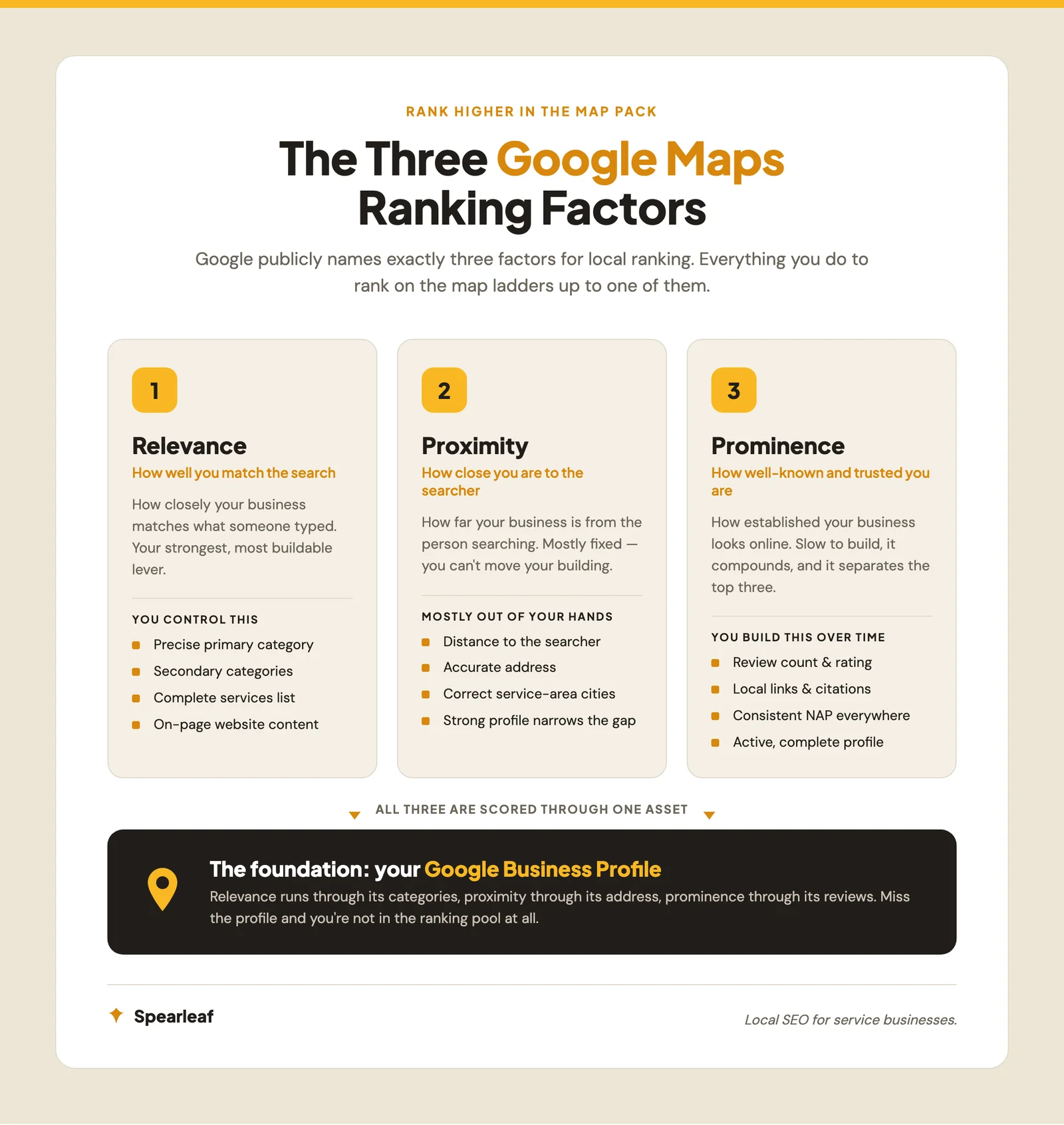
Google publicly names exactly three factors for local ranking: relevance, distance, and prominence. Everything you do in Google Maps SEO ladders up to one of them.
Per Google's own local-ranking help page, these three are the only factors Google officially names. Anyone selling you a precise percentage weight for each one is guessing, because Google has never published those weights. What you can do is build directly toward all three.
Relevance (how well you match the search)
Relevance is how closely your business matches what someone typed. A profile that lists "emergency plumber" and "water heater repair" matches more searches than a generic "plumber" listing with no services filled in.
You shape relevance through your primary category, your secondary categories, your services list, and the content on your website. The single biggest lever here is your primary category. Picking it precisely, "roofing contractor" rather than "contractor," tells Google exactly which searches you belong in.
Proximity (how close you are to the searcher)
Proximity, which Google calls distance, is how far your business is from the person searching. It's the factor you have the least control over, because you can't move your building.
What you can do is set your address and service area correctly so Google maps you to the right searches. A service-area business that defines its cities properly gets matched to those areas even without a storefront in each one. Proximity still favors the closest option, but a strong relevance and prominence profile narrows that gap.
Prominence (how well-known and trusted you are)
Prominence is how well-known your business is, and it's where most of the long-term work lives. Google draws it from your review count and rating, the number of websites that link to you, and your overall web presence.
This is the factor you build over time. Reviews, local links, citations, and a complete, active profile all feed prominence. It's slow, it compounds, and it's usually what separates the businesses in the top three from everyone else on page two.
Why your Google Business Profile is the foundation
Your Google Business Profile is the single asset Google scores all three factors through, which is why it's the first thing to get right.
Think of it this way. Relevance runs through your categories and services on the profile. Proximity runs through the address and service area you set on the profile. Prominence runs through the reviews and activity attached to the profile. Miss the profile and you're not really in the ranking pool.
So a claimed, verified, and fully completed profile is non-negotiable. That means an accurate primary category, complete hours, your full services list, real photos, and a correct address or service-area setup. I won't rehash the full setup here, because we cover it step by step in the GBP optimization checklist and in our guide to Google Business Profile optimization. If you haven't claimed your profile yet, start there first, then come back to the ranking work.
One warning, because I see this cost people their listings. Don't hand your profile access to services that promise to "boost CTR" by simulating clicks, and never buy reviews. Both put your whole profile at risk of suspension, and a suspended profile ranks nowhere.
How to rank higher on Google Maps: the owner's working list
Ranking higher comes down to consistent execution on the three factors, not a longer checklist. Here's the order I'd work in.
-
Claim and verify your profile. An unverified profile sits outside the ranking pool entirely. This is step zero, before anything else matters.
-
Set your primary category precisely. This is your strongest relevance signal. Choose the most specific category that describes your core service, not a broad catch-all.
-
Complete every field. Hours, services, service areas, description, and real photos. A complete profile signals an active, legitimate business, which supports relevance and prominence together.
-
Earn reviews steadily. Ask happy customers right after a good job, make it easy with a direct link, and respond to every review. Review count and rating feed prominence directly. Our guide on getting more Google reviews lays out the system.
-
Fix your NAP everywhere. Your name, address, and phone should match exactly across Yelp, Facebook, the BBB, and any directory that lists you. Mismatches create noise that works against your ranking.
-
Add local content and links. Service pages that name what you do and where feed relevance, and local links from community sites and associations feed prominence.
None of these are tricks. They're the same fundamentals Google has rewarded for years, done consistently. If your business is missing from the map entirely rather than just ranking low, our post on why your business might not be showing up on Google walks through the specific ways the profile layer breaks.
Does Google Maps SEO still matter with AI search?
Yes, and if anything it matters more, because AI answer engines lean on the same signals Google Maps SEO builds.
When someone asks ChatGPT, Gemini, or Google's AI Overviews for a local recommendation, those systems don't run Google's Map Pack algorithm. They use their own citation logic. But they draw on the same underlying inputs: a verified profile, consistent business information, genuine reviews, and authoritative web content.
So the work isn't split. Do your Google Maps SEO well and you position yourself to be recommended on both surfaces at once, the traditional map results and the newer AI answers. That's why we treat AI search optimization as part of the same effort rather than a separate project. The businesses that win the map are increasingly the ones AI recommends too.
What owners actually control (and what they don't)
The honest breakdown: you control relevance and prominence, you mostly can't control proximity, and nobody controls Google's exact formula.
You can pick the right category, complete your profile, earn reviews, and clean up your information. That's relevance and prominence, and it's most of the work. You can't move closer to every searcher, so proximity puts a ceiling on how far you'll rank for people across town, and that's normal. What you should be suspicious of is anyone claiming to guarantee a top-three map spot or sell you a precise ranking-factor weight. Google names three factors and publishes no weights. Guaranteed rankings are a red flag, not a service.
The encouraging part is that the discipline rewards businesses for being genuinely good and genuinely findable. Complete your profile, earn honest reviews, keep your information accurate, and describe your services clearly. That's the whole method, and it beats every shortcut over time.
The questions I hear most from owners trying to rank higher on Google Maps, answered plainly.
Ready to rank higher on the map?
Google Maps SEO comes down to three things Google actually names: relevance you build through categories and content, proximity you set correctly, and prominence you earn through reviews and web presence, all anchored to a complete Google Business Profile. Do them consistently and you show up for the nearby customers already searching, on both the Map Pack and the new AI answers. If you'd rather have a team build and maintain all of it in the right order, our local SEO program is designed to grow durable map visibility for service businesses, with no long contract, just the fundamentals executed consistently.
This article was written by Joshua Albanese, founder of Spearleaf, a local SEO and marketing agency based in Fort Myers, Florida. Joshua has built six businesses from zero using organic search and content, and he leads Spearleaf's SEO, AI search, and local strategy for service businesses across the U.S.
Frequently asked questions
What is Google Maps SEO?
Google Maps SEO is the work of getting your business to rank higher in Google's local results, especially the Map Pack, the block of three listings with a map that sits above the regular blue links. It focuses on the signals Google uses to rank local businesses: how relevant your profile is to the search, how close you are to the searcher, and how well-known and trusted your business is. Unlike national SEO, it leans heavily on your Google Business Profile rather than just your website.
How do I rank higher on Google Maps?
You rank higher by strengthening the three factors Google names for local search: relevance, proximity, and prominence. In practice that means picking the right primary category, keeping your business information complete and consistent everywhere, earning genuine reviews steadily, and building real local links and content. You can't move your building, so proximity is mostly fixed, but relevance and prominence are things you build over months of consistent work. There are no shortcuts that beat doing the fundamentals longer than your competitors.
Why is my business not showing up on Google Maps?
The most common reasons are an unverified or incomplete Google Business Profile, a wrong or missing category, inconsistent business information across the web, or simply being farther from the searcher than competitors. Sometimes the profile is fine and the issue is prominence: too few reviews or too little web presence to out-signal established businesses nearby. Start by confirming your profile is verified and your primary category is correct, then work on reviews and consistency.
How long does it take to rank on Google Maps?
There is no fixed timeline, and no honest agency promises one. A verified, complete profile can start appearing fairly quickly, but ranking for competitive searches usually builds over a few months as you earn reviews, keep your information consistent, and add local content. Newer profiles and low-review starting points take longer. Google controls placement, so the realistic goal is steady, compounding movement, not an overnight jump to the top three.
Is Google Maps SEO the same as running Google Ads?
No. Google Maps SEO earns organic placement in the Map Pack through relevance, proximity, and prominence, with no ad spend. Google Ads buys a separate paid placement that can appear above the organic map results and stops the moment you pause the budget. Spearleaf is a 100% organic, zero ad spend agency, so the map ranking we build is the earned kind that keeps working after the initial effort is done.
Want to rank higher on the map without guessing? See how our local SEO program builds durable visibility in the Map Pack.
Learn more →