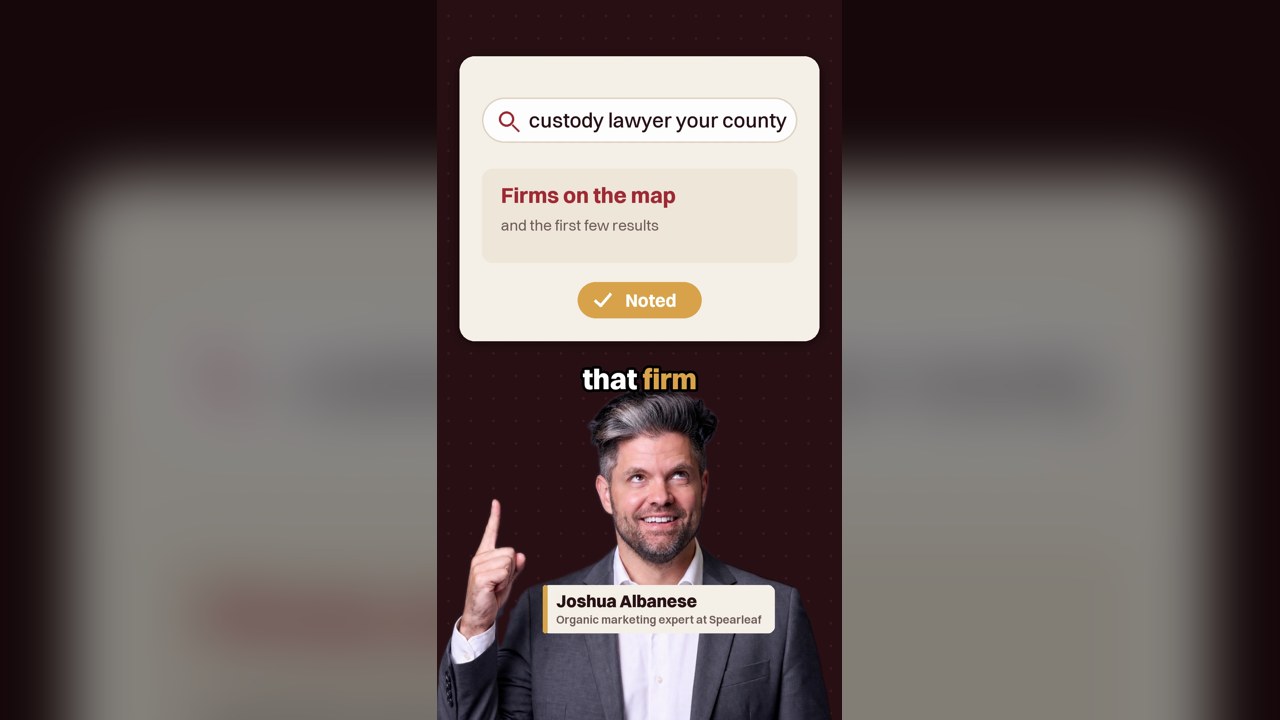
The best law firm websites to study before a redesign are the ones your next client opens in your town. Find them in local search, check them on a phone, and copy what helps callers reach you within bar rules. Watch Joshua Albanese walk through four steps for studying law firm websites in a short video.
What makes the best law firm websites worth studying?
The sites worth studying are the ones a potential client in your own town actually finds and uses. Google's Business Profile help page says local results are mainly based on relevance, distance and prominence. Check what each site does for a caller on a phone, then decide what to copy.
Many firms are good at the law and only need help getting found online. A redesign is the right moment to fix that. Google's guide to hiring an SEO calls a site redesign a great time to bring one in, the earlier the better.
One business owner's review of a marketing company described the goal plainly: "make a new website show up in Google searches". For a law firm, that means pages a scared person in your county can find, read on a phone and act on.
Why an award list is the wrong place to start a law firm website redesign
An award list shows sites built for other markets, judged mostly on looks. In a Google search for this phrase in October 2026, 6 of the top 9 results were example lists or design portfolios. Use those lists for fonts and photos, and look closer to home for what to copy.
Two of those six were design agencies showing their own clients, and two were legal software companies. Another owner's review of a marketing company reads: "They built a site that I explicitly said 'I do not want'". Bring your designer a brief built from your own market instead.
The firm at the top of your local map may have a site that looks a decade old. Google's local ranking also weighs distance and prominence, which includes reviews, so the look is not what put it there. Study what each site does, not how it looks.
Step one, find the law firm websites your clients actually open
- Search your main case type plus your town in a private browser window, such as "custody lawyer" and your county seat.
- Write down the firms in the map results and the first few regular results below them.
- Repeat for your next two case types, because the competing firms often change by matter.
- Ask ChatGPT and Google's AI the same question, phrased the way a worried client would ask it.
- Note which firm sites the answers point to. Google says AI Overviews include links to dig deeper.
- Note whether your own firm appears. One owner wrote: "I searched my business on Google, and nothing showed up." That gap is a local SEO job as much as a website one.
Step two, check each law firm website on your phone
Open each site on your phone, because that is where a worried client is likely to read it. Google's mobile-first indexing guide says Google uses the mobile version of a site for indexing and ranking.
Count the taps until you see a phone number you can tap to call. Write the count down, and do not call those firms to test them. Then note what fills the first screen: who the firm helps, where, and how to reach a person.
Run each home page through Google's PageSpeed Insights, which reports on mobile and desktop. Put your own site in the same list. Compare the mobile results side by side, so you see where your firm stands.
Step three, count the case type pages on each site
Note which case types get their own page on each site. A family law site with separate pages for relocation cases and grandparents' visitation can match more of what people type. Count those pages, then list the ones your firm does not have yet.
Clear case pages also tell callers what you do not handle. One business owner complained that calls came "for things that we did not service, or was not anywhere near our location". A page per matter helps the right callers find you.
Write each page about the matter, the process and the next step, in plain words. Have a lawyer at the firm approve every page before it goes live.
More things to judge on each law firm website
Beyond the phone number and the case pages, look for these on each site.
-
Attorney bios that show who the client will work with, the matters each lawyer handles and where each is admitted.
-
Reviews and results, shown with whatever disclaimers your state requires.
-
Plain answers to what callers ask first: how fees work, how long it takes and what happens at the consultation.
-
A clear next step on every page, such as call, text or book a consultation.
-
Spanish or other language pages, if local competitors offer them and your clients speak that language.
-
The office address and the counties the firm serves, so a caller knows you can help.
Why a story-first chat window is a risk on a law firm website
A chat that asks "what happened?" first can collect a stranger's facts before your conflict check. ABA Model Rule 1.18 treats a person who consults about hiring you as a prospective client. Ask for names first, show a clear warning, run the conflict check, then book the consultation.
Comment 2 to the rule says a consultation is likely when advertising invites information without clear warnings and the person responds. Comment 4 tells lawyers to limit that first consultation to what they need to decide. The story waits until the conflict check clears.
Say that person is the other side in a case you already have. Rule 1.18(c) can then disqualify the lawyer who heard harmful facts, and the firm with them. Rule 1.18(d) has narrow exceptions, so check your state bar's version.
Autoplay video and other law firm website features to skip
These features show up on award lists, and I recommend leaving them off your site.
-
Autoplay video with sound. A video that starts talking on a phone in a quiet house is the last thing a worried spouse wants. WCAG success criterion 1.4.2 requires a way to pause or stop audio that plays automatically for more than 3 seconds.
-
Pop-ups that cover the phone number on a small screen.
-
Settlement figures with no context. Results without the disclaimer your state requires can break the rules below.
-
Another firm's words or photos. Copy the idea, such as a page per case type, and write your own pages.
Bar advertising rules that apply to every law firm website
Your website is a communication about your services, so your state's advertising rules apply, and its version of each rule controls.
-
ABA Model Rule 7.1 bars false or misleading communications, including true statements that leave out a fact needed to avoid misleading.
-
Comment 3 to Rule 7.1 says past results can mislead if they create an unjustified expectation. An appropriate disclaimer may prevent that.
-
State rules change, so check the current text. New York dropped its "Attorney Advertising" label and its results disclaimer on June 1, 2026, per the New York State Bar Association.
-
The same summary says lawyers may still want to use "Prior results do not guarantee a similar outcome" to avoid misleading readers.
-
Claim to be a certified specialist only if an approved body certified you and the site names it, under Rule 7.2(c).
-
Include the name and contact information of at least one lawyer or firm responsible for the content, under Rule 7.2(d).
-
Have a lawyer at the firm approve every page, and check your state bar's current rules before launch.
Accessibility rules for law firm websites
The ADA lists the "office of an accountant or lawyer" among public accommodations, in 42 U.S.C. 12181.
-
The Justice Department's 2022 web guidance says the ADA's requirements apply to services public accommodations offer on the web.
-
The same guidance says there is no detailed federal web regulation for businesses, and it points to WCAG as helpful technical guidance.
-
Its examples to check include color contrast, alt text on images, captions on videos, labeled forms, keyboard access and zoom.
-
Tab through your site with the keyboard only, and see whether you can reach the phone number and the contact form.
-
Run PageSpeed Insights, whose lab data includes accessibility diagnostics, on your home page and your top case pages.
-
Ask your own counsel how these rules apply to your firm, since the law here keeps developing.
Step four, turn what you found into a one-page brief for your redesign
- List how many taps each local site takes to show a phone number, with your own count beside it.
- List the case type pages the local sites have and yours lacks, starting with the matters you want most.
- Write the next step a caller sees on each page: call, book, or a chat that asks for names first.
- Add the bar rule and accessibility items above as a checklist your designer must meet.
- Keep the award list for fonts and photos only.
- Save a copy of your current site and note which pages bring calls now, so the redesign keeps them.
How to measure whether the new law firm website works
Measure the same things you studied, before and after launch, with tools you already have. Google's Search Console Performance report shows which search queries bring people to your site. Record the tap count, the mobile PageSpeed Insights result and Search Console clicks for each page on launch day.
Check the case type pages in that report each month. Add a required "how did you hear about us" field to intake, and count signed cases by source. I explain that monthly review in my guide to law firm marketing.
The study takes an evening. Writing the missing pages takes weeks, and new pages can take a while to show up in search.
Build your law firm website around what callers need
Spearleaf's web design work maps the site around how your clients decide, with search structure built in from day one. Our team builds the site, and you own the site and the domain. A lawyer at your firm should approve every page before it goes live.
Talk to Spearleaf about web design
- Read the guide: law firm marketing.
- What drives the price: small business website cost.
- Start here: why no one is visiting your website.