
The fastest way to waste money on a local SEO agency is to hire one before you have fixed the free stuff yourself. This is the local SEO checklist I wish every owner ran first: 22 concrete things you can fix this week, grouped into your profile, your reviews, your website, and your citations. Do them and you will either rank better on your own or hand an agency a clean starting line instead of a cleanup bill.

I'm Joshua Albanese, and I built six businesses from zero using organic search before I ever ran an agency. The pattern I see over and over is owners paying for help with things they could have fixed in a weekend. So here is the actual list, in plain English, in the order I would work it.
What belongs on a local SEO checklist?
A local SEO checklist covers four areas in priority order: your Google Business Profile, your reviews, your website, and your citations. Google publicly names its three local ranking factors as relevance, distance, and prominence, and every item below ladders up to one of them. You cannot see the exact formula, and anyone selling you precise weights is guessing, but you can build directly toward all three.
Work these in order. The profile items move the needle most and cost the least, so they come first. The website and citation items compound more slowly, so they come later. Nothing here requires a budget or a single black-hat trick.
Google Business Profile (items 1 through 8)
Your profile is the foundation. It is the asset Google scores all three local factors through, and it is where I would spend the first afternoon.
-
Claim and verify your profile. An unverified or unclaimed listing cannot rank in the Map Pack. Search your business name on Google, claim the listing, and complete the verification Google asks for. This is item one for a reason.
-
Set the right primary category. Your primary category is one of the strongest relevance signals Google reads. Pick the most specific one that matches your core service, not a broad catch-all. A "roofing contractor" beats a generic "contractor" every time.
-
Add relevant secondary categories. If you genuinely offer more than one service, add secondary categories for them. Do not stuff the list with categories you do not actually serve, which muddies your relevance instead of sharpening it.
-
Complete your hours, including holidays. Wrong hours frustrate customers and signal a stale profile to Google. Set accurate regular hours and update special hours for holidays so nobody drives to a closed door.
-
Fix your address or service area. If customers come to you, your address must be exact. If you travel to them, set a service area instead of a fake storefront. Getting distance right depends on this being correct.
-
Fill out every service and description. List your actual services with short, honest descriptions, and write a business description that names what you do and where. Empty fields are relevance you are leaving on the table.
-
Add real photos, and keep adding them. Upload genuine photos of your work, team, and location, not stock images. A profile with fresh, real photos reads as active and trustworthy to both customers and Google.
-
Turn on messaging and answer questions. Enable messaging if you can respond promptly, and answer the questions people post in the Q&A section yourself before a stranger guesses for you.
That is the single highest-impact block on this list, and it is where Google Business Profile optimization always starts. If you want the deeper version, our GBP optimization checklist walks through each field.
Reviews and reputation (items 9 through 13)
Review count and rating are prominence signals Google names directly, and they are the first thing a nervous customer checks before calling. Reviews are a habit, not a one-time task.
-
Ask every happy customer for a review. The biggest reason businesses have few reviews is that they never ask. Ask right after a good experience, when the goodwill is fresh, every single time.
-
Make it a one-tap link. Get your Google review link, shorten it, and put it in a text or email so leaving a review takes seconds. Friction is what kills your review rate.
-
Respond to every review, good and bad. Replies signal an active, accountable business to Google and to future customers. Thank the good ones and answer the bad ones calmly and factually.
-
Never buy, gate, or fake reviews. Buying reviews or filtering out unhappy customers before they post violates Google's policies and puts your whole profile at risk. Ethical review-building is the only kind that lasts.
-
Aim for a steady trickle, not a burst. A sudden pile of reviews looks manufactured. A few honest reviews every week reads as a real business doing real work, which is exactly what it should be.
If your review flow has stalled, our guide on how to get more Google reviews lays out the full system.
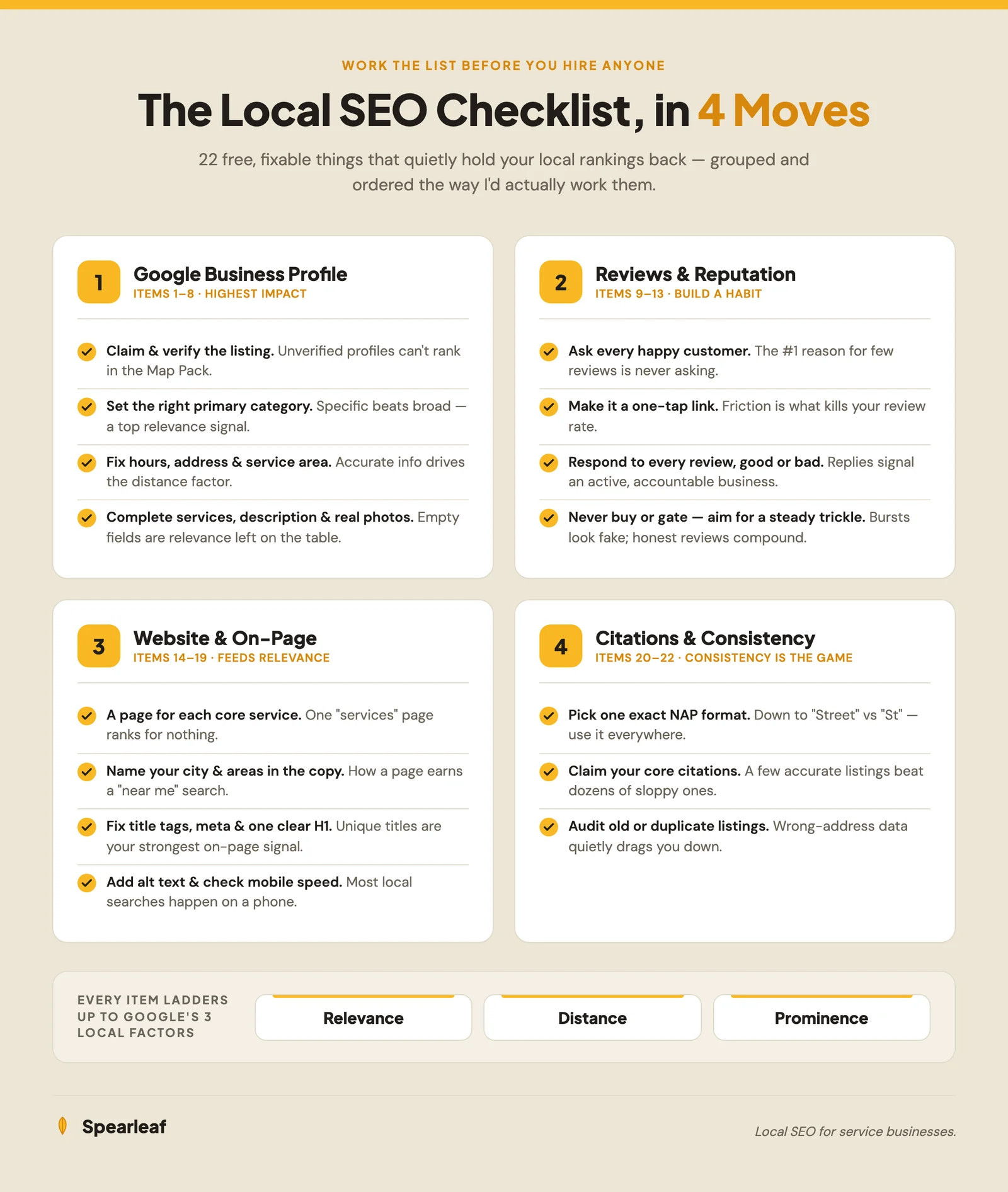
Website and on-page (items 14 through 19)
Your website feeds relevance. Thin, one-page sites give Google almost nothing to match, so this block is about giving it real content to rank.
-
Build a page for each core service. One page per service, each targeting the exact phrase customers search, tells Google precisely what you offer. A single "services" page trying to cover everything ranks for nothing.
-
Name your city and areas on those pages. Write your city and the neighborhoods you serve into the actual page copy, beyond the footer alone. This is how a page earns a "near me" search instead of hoping for it.
-
Fix your title tags and meta descriptions. Each page needs a unique title tag with the service and city, and a description that reads like a human wrote it. Duplicate or empty titles waste your strongest on-page signal.
-
Use one clear H1 per page. Each page should have a single H1 that states the service and location plainly. Skip the clever wordplay; say what the page is about.
-
Add descriptive alt text to images. Alt text helps accessibility and gives Google another honest signal about your content. Describe the image; do not stuff it with keywords.
-
Check your page speed on mobile. Most local searches happen on a phone, and a slow page loses both rankings and customers. Run your site through Google's free PageSpeed Insights and fix the biggest offenders, usually oversized images.
The full version of this block lives in our on-page SEO checklist, which goes deeper on titles, intent match, and schema.
Citations and consistency (items 20 through 22)
A citation is your business information listed on other sites like Yelp, Facebook, and the Better Business Bureau. Consistency is the whole game here.
-
Pick one exact NAP format. Decide on one exact version of your name, address, and phone number, down to "Street" versus "St," and use it everywhere. Conflicting formats create noise that works against you.
-
Claim your core citations. Set up and verify your listings on the big directories your industry uses, then match them to your chosen format. A handful of accurate, claimed citations beats dozens of sloppy ones.
-
Audit for old or duplicate listings. Search your business name and phone number to find outdated addresses, closed-location listings, or duplicates, then correct or remove them. Old data pointing to the wrong place quietly drags you down.
Get these three right and your business information reads as accurate and trustworthy across the web, which is exactly what Google and AI answer engines both want to see. Speaking of which: doing this list well also positions you to be recommended by AI search, because AI search optimization leans on the same verified profile, consistent data, and real reviews.
When is it actually time to hire someone?
Hire help when you have worked this whole list and still cannot out-signal established competitors, or when the ongoing work is eating time you do not have.
The truth is that this checklist is most of what a good agency does in month one. If you run it yourself, you will know whether you had a fixable profile problem or a real competitive gap. Plenty of owners find that a claimed profile, a review habit, and a few real service pages were the entire fix.
Where owners genuinely hit a wall is the compounding work: building out dozens of service and location pages, cleaning citations across the web month after month, and earning links from your community. That is durable, unglamorous work that rewards consistency over cleverness. If you would rather hand it off after doing the basics, that is a fair trade. Just do the basics first so you are paying for real gains, not for a cleanup.
The questions I hear most from owners deciding whether to work this list themselves or hire out, answered plainly.
Ready to hand off the rest?
Here is the whole checklist in one breath: verify and complete your Google Business Profile, build a real review habit, give your website a page per service with your city on it, and keep your business information identical everywhere. That is most of what moves local rankings, and it is all free to start. Do it well and you show up for the nearby customers already searching, on both Google's Map Pack and the new AI answers. If you have worked the list and want a team to build and maintain the rest in the right order, our local SEO program is built to grow durable lead flow for service businesses, with no long contract, just the fundamentals executed consistently.
This article was written by Joshua Albanese, founder of Spearleaf, a local SEO and marketing agency based in Fort Myers, Florida. Joshua has built six businesses from zero using organic search and content, and he leads Spearleaf's SEO, AI search, and local strategy for service businesses across the U.S.