Ranking a local business in 2026 comes down to seven levers that reinforce each other. Strong local SEO services still start with your Google Business Profile, citations, and reviews, then move to your website, schema, and speed. The new layer on top is AI search: getting named when buyers ask ChatGPT, Gemini, or Google's AI Overviews who to hire.
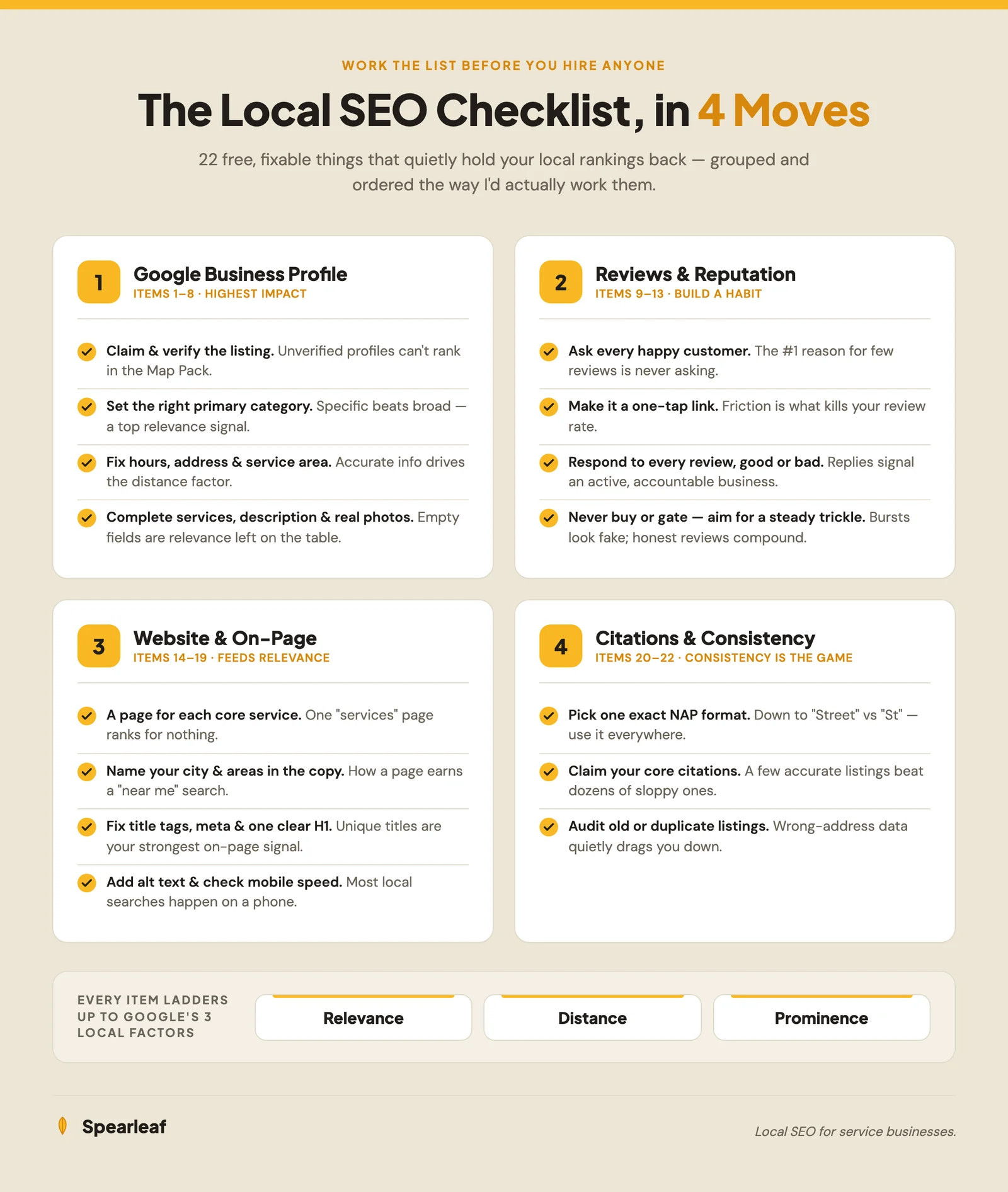
The local SEO ranking factors that matter most in 2026
Work these seven levers in order, because each one makes the next one pay off faster.
- Google Business Profile is the Map Pack listing that wins nearby searches first.
- NAP and citation consistency give search engines one clean set of business facts.
- Review velocity keeps recent, responded-to reviews flowing to your profile.
- Service and location pages give Google real pages to rank for each job and city.
- Schema and structured data hand machines a clean read of who and where you are.
- Site speed and technical health keep pages fast, crawlable, and mobile-first.
- AI search optimization earns citations when buyers ask an AI assistant who to hire.
Start with Google Business Profile optimization
Your Google Business Profile does more for nearby visibility than any other single asset, so Google Business Profile optimization comes before website work.
Categories and services
Pick the most specific primary category, then add every relevant secondary category. List each service you offer with a short, honest description.
Photos, posts, and hours
Add real photos of your work, team, and location. Post updates weekly and keep hours, holidays, and attributes accurate.
Reviews and Q&A
Reply to every review, good or bad. Seed the Q&A section with the questions buyers actually ask before they call.
Messaging and the booking link
Turn on messaging only if you can answer fast. Point your booking or website link straight to the page that converts.
Fix NAP and citation consistency
NAP means name, address, and phone number. Search engines cross-check those three facts everywhere they appear. When your listing says Suite 200 and an old directory says Ste. 2, that mismatch chips away at the trust that drives ranking.
Per Google's guidance on how local results are ranked, prominence is built partly on consistent information across the web. Pick one exact format for your name, address, and phone. Then use it everywhere, from your website footer to every directory.
Clean up the big aggregators first: Google, Bing, Apple Maps, Yelp, and your industry directories. Fix duplicates, close dead listings, and correct anything that moved when your address or number changed.
Build review velocity and protect your reputation
Reviews are a ranking factor and a conversion factor at the same time. A recent, steady stream of reviews signals an active, trusted business to both Google and the buyer reading your profile.
Velocity matters more than a single big number. Ten reviews over the last three months read as healthier than fifty that all landed two years ago. Ask every satisfied customer, and make the ask easy with a short link.
Respond to all of them. A calm, specific reply to a hard review shows the next reader how you handle problems. That response often does more for trust than the star rating itself.
Write service pages and location pages that rank
Your profile gets you into the Map Pack, and your website ranks for everything below it.
Core service pages
Give every main service its own page. Explain the problem, your process, and the outcome in plain language a buyer understands.
Location pages
Build a real page for each city you serve, with local detail. Skip the thin doorway pages that only swap the city name.
Answer-first copy
Open each page with a direct answer to the question that brought the visitor. AI engines and featured snippets both pull those clean opening lines.
Add schema and structured data for local search
Schema markup hands search engines and AI a machine-readable copy of your business facts, per Google's LocalBusiness structured data guidelines.
- LocalBusiness markup with your name, address, phone, hours, and geo-coordinates.
- Service schema for each core service you want to rank for.
- FAQPage markup on pages that answer common buyer questions.
- Review and AggregateRating markup where you display real ratings.
- Breadcrumb and Organization markup to connect your pages and brand.
Fix the technical and site speed issues that hold local SEO back
A slow, hard-to-crawl site cancels out good rankings work. If the page loads slowly on a phone, buyers leave before they call, and Google reads that bounce.
Watch your Core Web Vitals: loading, interactivity, and layout stability. Keep largest contentful paint under 2.5 seconds on mobile, and stop the layout from jumping while the page loads.
The rest is housekeeping that compounds. A clean sitemap, working internal links, HTTPS, mobile-first design, and no broken pages keep both crawlers and AI engines moving through your site.
AI search optimization: getting cited by ChatGPT, Gemini, and AI Overviews
Search is no longer only ten blue links. When a buyer asks ChatGPT, Gemini, Perplexity, or Google's AI Overviews who to hire, those engines name specific businesses.
The same fundamentals feed them: a strong Google Business Profile, consistent citations, real reviews, and answer-first pages with clean schema. AI engines favor businesses with steady, verifiable signals across the web.
This is where AI search optimization becomes its own workstream. You structure pages so an assistant can quote them, then build the third-party mentions that make your name safe for an AI to recommend.
Run your 2026 local SEO playbook with Spearleaf
Spearleaf is a Fort Myers SEO and AI search optimization agency founded by Joshua Albanese. He built six service businesses from zero with organic marketing. His own Fort Myers brand ranked at the top of local results in about 14 days (individual results vary).
We build the whole engine in one engagement: local SEO, Google Business Profile optimization, and AI search optimization. No ad spend, no long lock-in, month-to-month after the first 90 days.
Book a discovery call or call (239) 920-7750 to map your next 90 days.